How do I interpret the evaluation criteria levels?
In the Trendmanager, trends are evaluated systematically to transparently represent their relevance and urgency. The basis for this is three core criteria: influence, mainstream adoption (time of adoption), and competencies. Influence describes the strength of the impact a trend is expected to have. It can relate to different levels of the company, such as products and services, internal processes, or employees and customers. Mainstream adoption evaluates when the trend is expected to be adopted by the majority of market participants within an industry. What is sought is the moment when the early majority takes up the trend. Competencies show how well a company is already prepared for the trend, including initial projects, services, processes, or prototypes.
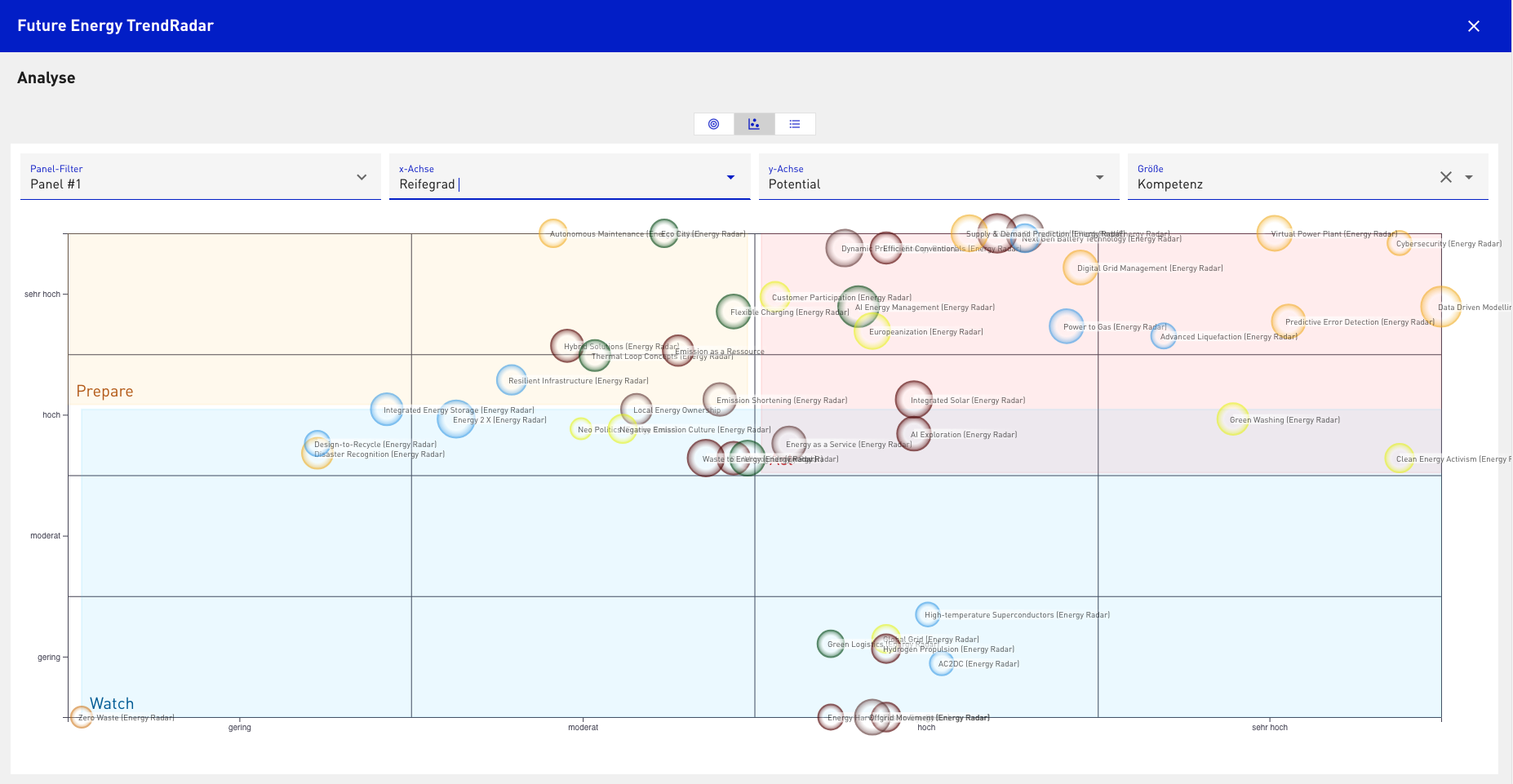
Classification into recommended actions
The criteria evaluations are not considered in isolation, but translated into concrete recommended actions. Influence, adoption, and competencies are combined to obtain a clear recommendation: from „observe“ through „analyze“ to „implement“. The calculation ensures a uniform, traceable classification independent of personal assessments. This makes it visible whether a trend should only be monitored, whether initial competence building is needed, or whether immediate measures are required.
Interpretation of the evaluation scale (6-point scale)
All three criteria are classified in the Trendmanager on a 6-point scale from „very low“ to „very high“. The levels in detail:
Influence
- Very low: Possible innovations are conceivable but currently not relevant.
- Moderate values: First developments visible, potential present.
- High values: Trend has already established itself.
- Very high: Trend will have far-reaching effects on business areas or product ranges.
Mainstream adoption
- Very low: Trend is still in research or development.
- Moderate values: First market-ready products available for early adopters.
- High values: Target group grows, trend reaches a broader mass.
- Very high: Broad acceptance, tipping point exceeded.
Competencies
- Very low: Company has not yet engaged with the trend.
- Moderate values: First engagement at knowledge level.
- High values: Planning of concrete projects.
- Very high: Prototypes, services, or processes already implemented.
Recommended actions for the 6-point scale
- 1–2 (very low/low): Observe – trend currently of little relevance
- 3–4 (rather low/rather high): Analyze – first developments recognizable, monitoring and knowledge building advisable
- 5–6 (very high): Implement – trend strategically relevant, implementation in strategies, projects, or offerings recommended
Interpretation of the 100-point scale
For detailed analyses, a 100-point scale is additionally available. It is used above all for potential assessment, maturity, and competencies. With the finer scale, trends can be distinguished more precisely, small gradations made visible, and strategic decisions such as benchmarking or readiness assessments made on a more well-founded basis.
Recommended actions for the 100-point scale
- 0–25 points: Observe – trend at an early stage or currently of little relevance
- 26–50 points: Analyze – first relevance recognizable, detailed analysis and knowledge building advisable
- 51–75 points: Pilot – trend becoming more important, prototypes or pilot projects advisable
- 76–100 points: Implement – trend strategically important, competencies present or to be built immediately, concrete implementation advisable
Customizable criteria sets
Companies can fully adapt the evaluation logic in the Trendmanager by adding new criteria, renaming or removing existing criteria, changing the weightings, or freely choosing scales. This allows an evaluation system to be developed that exactly matches the strategy, industry, or innovation culture of the company. Examples of additional criteria: strategic fit, sustainability relevance, customer benefit.
Classification into readiness assessments
In addition, trends can be evaluated via a readiness assessment. This examines how well a company can actually implement a trend. In addition to the competence evaluation, factors such as resources, strategic fit, and existing projects are included.
This creates a clear picture:
- Which trends can be implemented in the short term
- Where foundations must first be created