

The term "trend analysis" has 3 different meanings:
- In the financial sector, it refers to the price development of stocks.
- In statistics, it refers to the estimation of time series, such as unemployment figures (see also the Wikipedia article).
- In trend research, it refers to the systematic identification and evaluation of changes that will shape society and the economy in the coming years.
This article is about the third point.
Definition: what is trend analysis?
Trend analysis is about systematically identifying and evaluating transformation phenomena in society and the economy in order to better prepare for the challenges of the future.
Such transformation phenomena can be new technologies and inventions or shifts in people's attitudes and values.
Trend analysis helps decision-makers in politics and business forecast the future development of societies, industries, and markets.
Methods of trend analysis
There are various methods of trend analysis. The methodology we use at TRENDONE to identify trends is evidence-based. That is, we deliberately watch for initial "weak signals" of change. Such weak signals can be new inventions, technologies, or business models that are innovative and already exist in the present.
Our trend scouts look for these first weak signals worldwide and across industries. Because big changes usually announce themselves on a small scale first. In the 1st step of our trend analysis, our trend scouts help us identify these signals, which we call Micro Trends.
In the 2nd step, our analysts cluster similar Micro Trends that appear across different industries and regions. We call the resulting clusters Macro Trends. An example of such a Macro Trend is "cybersecurity" or "ethical consumption."
In the final step, the Macro Trends are placed in a higher-level context. From this, we then derive the Megatrends. Megatrends are major transformation processes that will massively shape our society over the coming decades. Examples of such Megatrends include "artificial intelligence" or "Planet Centricity." Several Macro Trends thus flow together into a higher-level Megatrend.
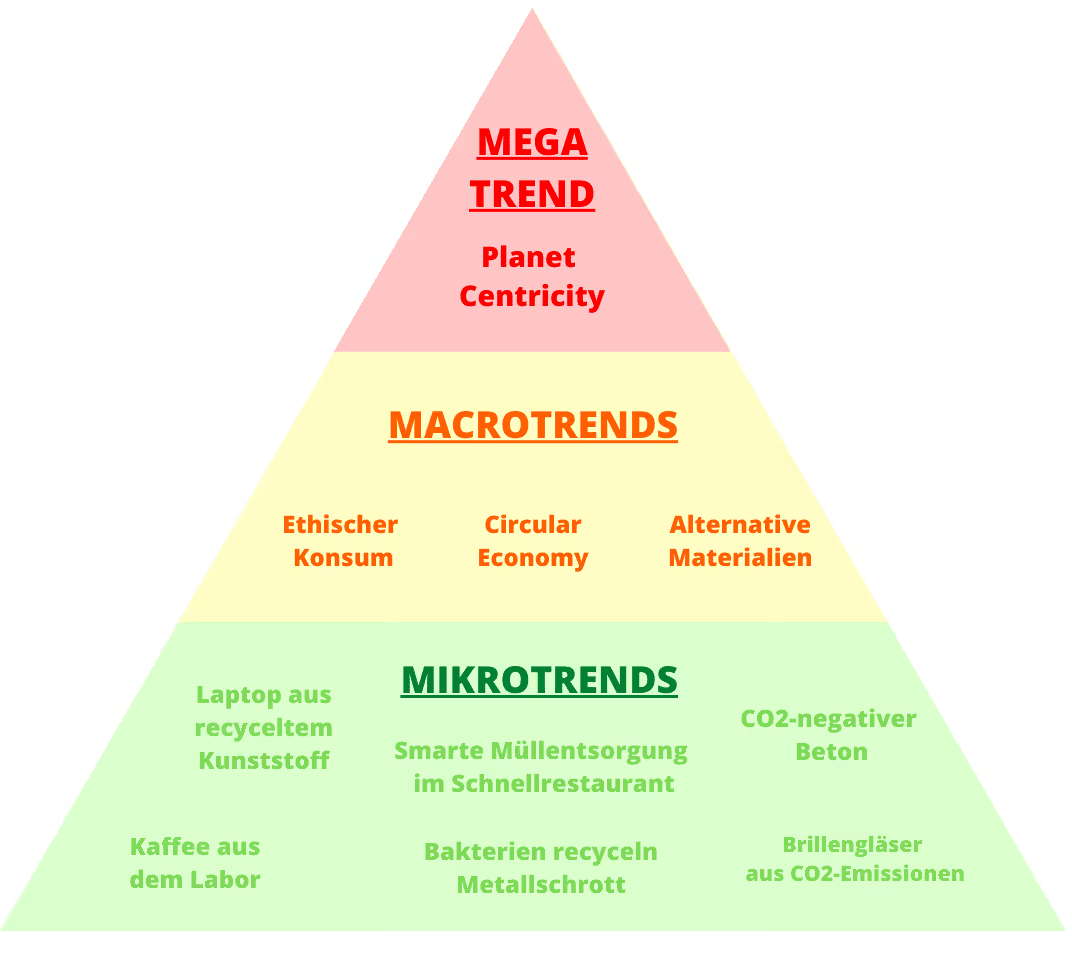
The advantage of this approach is that the trend analysis is based on real changes that are already happening.
Trend analyses in systematic innovation management
Trend analyses are an important foundation for systematic innovation management. A trend analysis should stand at the beginning of a systematic innovation process, because it provides a comprehensive picture of expected market changes and reveals possible innovation opportunities.
With a tailored trend analysis, you can identify the trends most relevant to you and evaluate the specific impact on your industry and your company.
The role of trend analysis in the innovation process is illustrated by the 5-phase model for effective trend management:

Trend analysis in the innovation process
In steps 1 and 2, trends are identified and evaluated. This is an important foundation for systematic innovation management, allowing you to spot change early and derive valuable innovation opportunities.
Trend analysis example
There are many possible criteria to evaluate a trend:
- impact on the company,
- speed of adoption,
- disruptive potential,
- revenue potential,
- efficiency potential,
- and many more.
One example of a trend analysis is our SME Trend Radar. In it, more than 150 mid-market companies evaluated the trends we identified against two criteria:
- their impact on the company, and
- their estimated mainstream adoption.
The result is a Trend Radar in which the individual trends are categorized as "Act," "Watch," or "Prepare" based on their evaluation:
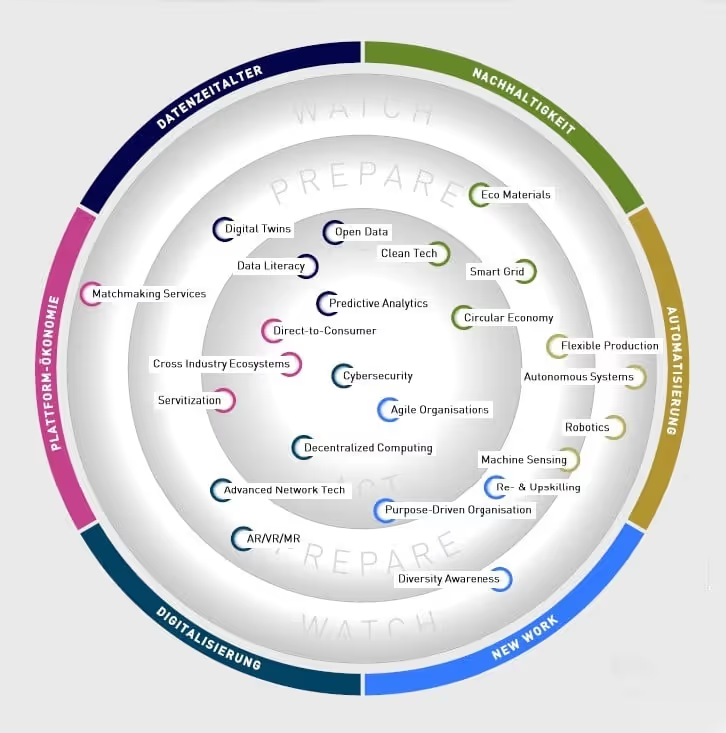
You can download the full SME Trend Radar with analysis here.
How do you conduct your own trend analysis?
Our Trend Manager is an innovation tool you can use to run your own industry- and company-specific trend analysis.
With the Trend Manager, you can identify and evaluate the most important trends in your area. From this, you can build a tailored Trend Radar that shows you exactly which trends play the most important role for you right now.
With your own Trend Radar, you can also keep an eye on trend developments over the long term and never miss important changes.
TRENDMANAGER
Your edge in working with trends
With the Trend Manager, you create the content foundation for strategically grounded innovations.