Megatrends are transformation processes that will influence our society over the long term and on a deep level.
In the technology space in particular, this change is becoming faster and more complex. Ongoing digitalization and advances in artificial intelligence are current examples.
At TRENDONE, we observe these developments and bring them together in our TRENDONE Trend Universe. We then visualize our Trend Universe like a map in our Megatrend Map.
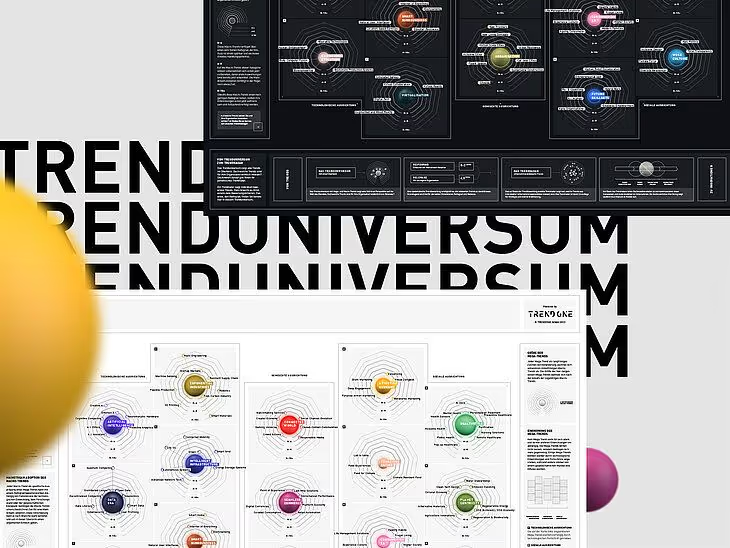
The Trend Universe with 17 Megatrends and 120 Macro Trends
The Megatrend Map makes complex, highly dynamic change visible and easier to understand. Megatrends show which developments will shape our society over the long term.
On the current Megatrend Map, you will find 17 megatrends that will significantly shape our future. Among them are 7 technological megatrends we would like to introduce here:
1. Artificial Intelligence
Whether "digital personal assistants" or "smart speakers" such as Apple's HomePod, Amazon's Echo, or Google Assistant—more and more AI-based systems are already conquering our everyday lives.
And AI research keeps making rapid progress.
Neural networks, or deep learning, enable AI algorithms to learn. Cognitive computing simulates human thought processes, so complex tasks can be solved autonomously.
The deeper AI penetrates our everyday lives, the clearer the potential dangers of AI-based processes become.
This is particularly evident with predictive analytics, where AI systems support human decision-making (e.g., in credit decisions or recruiting). Many algorithms amplify the biases they absorbed during development.
This makes trust in AI, or AI trustability, a decisive factor for the future acceptance of the technology.
2. Data Era
The amount of data we produce globally is growing exponentially. Whether living beings, devices, or machines—almost everything can now be captured and tracked.
Using such data intelligently will become a major challenge. Not only its security matters, but also a thoughtful approach to handling it.
The following developments will shape the Data Era:
- The proper handling and correct interpretation of collected data will become a standard qualification. Data literacy is the ability to work competently with large amounts of data.
- Smart data solutions reduce the volume of data already before analysis to useful, high-quality data.
- Data-driven insights enable targeted user profiling. Through hyperpersonalization of content and services, individual users can be understood much better.
- Thanks to open data, much data is made openly accessible and freely usable.
- Approaches such as decentralized computing shift computing power across the internet's infrastructure and allow data to be processed faster.
- Quantum computers promise even faster analysis of data in the future.
- Distributed ledger technologies such as blockchain open up new business and service models. They also enable tamper-proof e-voting systems or the management of digital rights.
A central role in all of this will be played by cybersecurity. Protecting privacy and ownership will become a constant race.
3. Engineered Evolution
Humans extend their natural abilities and senses through technology.
The development ranges from wearables that can be worn on the body to human enhancement technologies that are permanently connected to the body, for example as implants. This not only removes personal limitations but also enables enhanced sensory perception.
In bioengineering, principles from engineering and the natural sciences are applied to tissue, cells, and molecules of natural systems. Gene technologies such as CRISPR-Cas, in particular, promise not only to cure diseases but also to develop new resistant plant varieties or animals with specific traits.
Brain-computer interfaces enable bidirectional information exchange between humans and machines and lead to a fusion at the mental level as well.
4. Exponential Industries
Industrial and manufacturing processes are undergoing exponential change:
- 3D printing increasingly overcomes the limitations of conventional production methods, allowing near-unlimited freedom in shaping.
- Through machine sensing, machines perceive their environment via technologies and sensors.
- Through nano engineering, materials can be manipulated at the atomic level, giving them new functions and properties.
- Smart materials adapt to new environmental conditions. They extend the functional range of a material or make it easier to recycle or compost.
- Robotics enables ever more automation of manufacturing tasks previously done by humans.
- Additive manufacturing, decentralized production, and predictive demand analytics enable flexible production.
- Value chains are increasingly becoming resilient supply chains that are robust thanks to agility, transparency, and sustainability and can be relocated quickly.
As a result, more and more innovations emerge at the intersections of formerly separate industries—the so-called overlap markets. Once-separate industries thus become drivers of innovation.
5. Intelligent Infrastructure
The infrastructure of the future faces major challenges—particularly with regard to mobility and energy supply.
In terms of energy supply, the following developments lie ahead:
- Intelligent power grids, the smart grids, will automatically manage the generation, consumption, and storage of energy.
- The energy transition will lead to more and more energy storage systems.
- Green IT supports energy saving through suitable technologies and the optimization of energy and resource use across the production, operation, and recycling of technical devices.
Mobility will also continue to evolve:
- Connected mobility bundles different mobility solutions so people can seamlessly combine offerings.
- Autonomous systems such as self-driving cars and other autonomously moving and flying systems will become widespread.
Our infrastructure will become ever more intelligent. The prerequisite for this is advanced network tech, which includes technologies such as 5G, NFC, and laser, as well as the transmission of energy.
Powerful city operating systems enable smart cities, where information and communication technologies interact with sensor networks to manage flows of goods, people, traffic, or energy consumption.
6. Smart Surroundings
Our environment is hyper-connected and becoming increasingly intelligent.
This development will continue in the following directions:
- Whether in your own home (smart home), in stores, or in public spaces, sensors will capture living beings and objects. This data capture becomes the basis for a wide range of applications and services.
- The complete connectivity of all everyday objects in the Internet of Everything (IoE) creates further intelligent solutions for our digitally connected lives.
- By combining sensors, various camera technologies, and AI applications (everysensing), not only can things and living beings—including biometric data—be captured, but also their interaction with the environment. This makes autonomous environments such as autonomous stores possible.
- Multi-touch surfaces on displays continue to gain in importance. Interactions through voice, touch, or gesture recognition via so-called natural user interfaces will continue to grow.
- Personal protection technology is increasingly used for preventive protective measures and passive safety systems to detect dangers in advance and protect us in critical situations.
- With location-based services, users can access specific, location-based offers and services on their mobile devices depending on where they are.
7. Virtualisation
The development of ever-better and more affordable virtualization technology opens up many new possibilities:
- COVID-19 triggered a surge in the development of digital tools that enable virtual collaboration (virtual collaboration) and support flexible, agile ways of working.
- Everyday life can become a "remote experience" (remote X). Examples include online shopping and new virtual experiences such as visiting a museum or attending a concert.
- In industry, advanced sensors make it possible to create complex simulations with the digital twin, which is also used in environmental protection and healthcare.
- Augmented, mixed and virtual reality deliver a new level of fusion of the digital and analog. These forms of virtual interaction can be used for virtual training in healthcare or in gaming.
TRENDMANAGER
Your edge in working with trends
You can find more examples of new technologies and their applications in our Trend Manager. There, we show you concrete innovation best-practice examples straight from the field.