


Measure what is measurable. Make measurable what is not.
Galileo Galilei
"Measure what is measurable. Make measurable what is not." Galileo Galilei’s motto from the 16th and 17th centuries still resonates today when it comes to expressing reality in numbers. Companies, too, measure all kinds of processes and developments to optimize them and make them more efficient. But what about more qualitative dimensions – creative ideas, approaches and new developments? Can innovation be measured too?
Strategic success indicators with steering power
Today, measuring your own work processes is considered professional, goal-oriented and a promise of success. For this we draw on so-called Key Performance Indicators (KPIs) – or simply "metrics" in everyday language. The word "indicator" comes from the Latin indicare, meaning "to point out".
That is exactly what KPIs are supposed to mean if you really use them effectively: they are signals or pointers to certain developments in the future. Understood this way, KPIs are not just numbers but strategic success indicators. KPIs help you steer activities in the desired direction.
KPIs help with allocating budgets and with justifying those decisions afterwards. What matters is that companies always tailor KPIs individually to their strategy. Only then do metrics help you recognize when a particular activity is deviating from the strategy.
The right framework for meaningful measurement
But what are the basic conditions for measuring meaningfully with KPIs? Innovation leads need to ask themselves two questions:
- Which goal or strategy is to be tracked with the KPIs? KPIs that do not support the execution of a strategy or progress toward a goal are not useful.
- What are the most important KPIs to focus on? A few KPIs with strong explanatory power are more valuable than many different metrics. Focus is decisive.
Once you have defined your KPIs, you can also assign the personnel resources and clear responsibilities. You should establish fixed structures for regularly reviewing, documenting, analyzing and communicating metrics, and for proposing measures.
Measuring innovation: Five important KPIs to start with
KPIs are not an end in themselves – it is the right metrics that matter. This is especially true when measuring innovation. The golden rule applies here too: less is more. We introduce five important indicators with which you can drive more impact in your innovation activities right from the start.
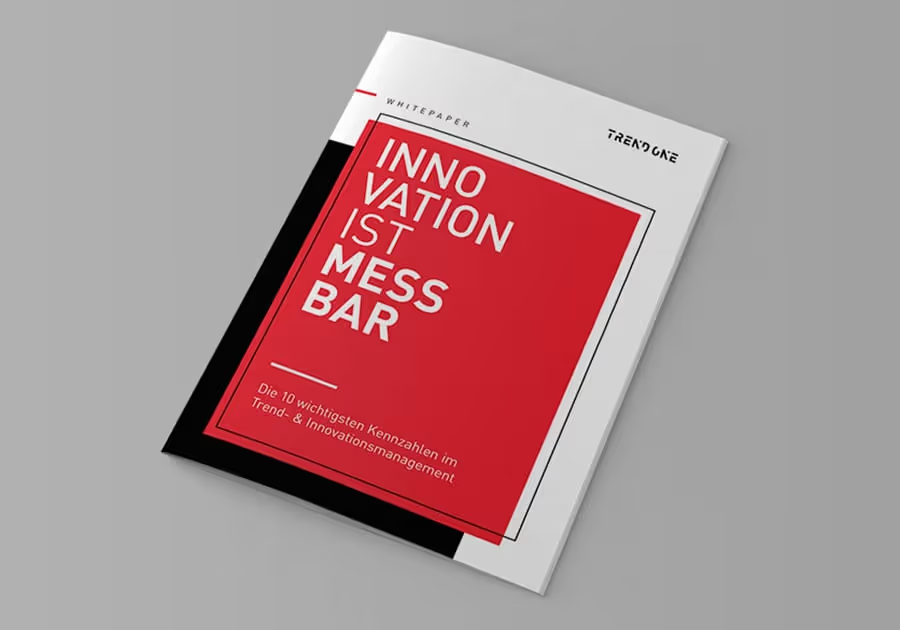
Whitepaper: Innovation Is Measurable
The TRENDONE whitepaper "Innovation Is Measurable" reveals the 10 most important KPIs in trend and innovation management.
Innovation KPIs help you assess your success, serve as a strong communication tool, and underline the importance of trends and innovation within your company.
1. Relevance Rate: How well do you separate the signal from the noise?
(Number of relevant trends / Total number of trends) x 100
At the beginning of the innovation process, the analysis and evaluation of trends is indispensable. Look less at the total number of trends you have identified. The volume varies greatly depending on the observation period, industry or type of trend. Instead, filter out the trends most relevant to your company.
Aim for a relevance rate between 10% and 25%. Below that threshold, you are already too narrowly focused at the start of the innovation process. Above it, you risk losing focus.
For evaluation and visualization, use the trend radar methodology. By prioritizing into three areas – Act, Prepare and Watch – you can identify the most relevant trends.
2. Participation Rate: How do you avoid the "Not-Invented-Here syndrome"?
(Number of employees involved / Total number of employees) x 100
Involve the right stakeholders as early as possible. This metric, too, is not about sheer volume – it is about the right ratio.
Depending on your company size, aim for a participation rate between 1% and 4%. Below the threshold, you will struggle with acceptance issues. Above it, you will spend a great deal of time on information sharing and alignment.
Create a stakeholder analysis and identify the key people. Use an established online tool such as the Trendmanager to communicate with stakeholders.
3. Conversion Rate: How do you increase the connectability of trends?
(Number of trends transferred into the next process step in period t / Number of all identified trends in period t) x 100
The higher the conversion rate, the more effective your trend management. Trends are not an end in themselves. You should always carry trends into the next stage of use, for example into innovation fields.
For visualization, use a traffic-light system with thresholds. If you fail to transfer trends into a follow-on step within the defined period, you should analyze their implications for your company. Valuable insights emerge about what level of maturity, scale, importance and orientation a trend needs to have.
In the preparation of trends, place a focus on the implications. What opportunities and risks arise for the industry, business area, target group, product or processes in use?
4. Degree of Innovation: How do you develop more disruptive ideas?
Novelty of the idea x Diffusion speed of the idea
The higher the degree of innovation, the greater an idea’s disruption potential. This KPI is important for companies that want to address and create new markets beyond their existing core business.
Increase the degree of innovation of ideas by systematically frontloading methods such as scenarios or innovation fields. They serve as guardrails in the idea phase and ensure from the outset that you develop ideas only in the truly value-creating areas.
If you want to increase the share of incremental ideas, use established procedures such as the company suggestion system. Business units that operate close to the market find it easier to develop ideas that are closely aligned with the core business.
5. Success Rate: How quickly do you generate learnings?
(Number of successfully executed experiments in period t / Total number of experiments in period t) x 100
In contrast to the KPIs listed above, the success rate comes into play later, when it is about validating the ideas and concepts you developed earlier. It is measured by the number of successful experiments. The higher your success rate, the more successfully you and your team gain useful insights.
Successful teams have a success rate above 60%. This has a positive impact on employee satisfaction. Capture your insights in an online journal. This puts you in a position to recognize patterns and name recurring success factors.
Create an institutionalized environment for experimentation, such as lab formats. Here you can validate ideas and concepts through a defined rhythm of experiments.
Measuring innovation: Further KPIs to dive deeper
KPIs help you assess your innovation success and keep control of the effectiveness of your measures. Our whitepaper "Innovation Is Measurable" contains, in addition to the KPIs listed above, five more of the most important metrics for successful trend and innovation management:
- Alignment Index: How well is your innovation management synchronized with all departments?
- Outcome Rate: How many innovation projects do you complete successfully?
- Development Speed: How quickly do you bring innovations to market?
- Development Costs: How efficiently do you deploy your innovation budget?
- Innovation Rate: How strong is your company’s innovation power?
Not every KPI is suitable for every company. Choose the most relevant KPIs with which you can meaningfully measure innovation, and add to them over time if needed.
Measure innovation already in the Fuzzy Front End of Innovation
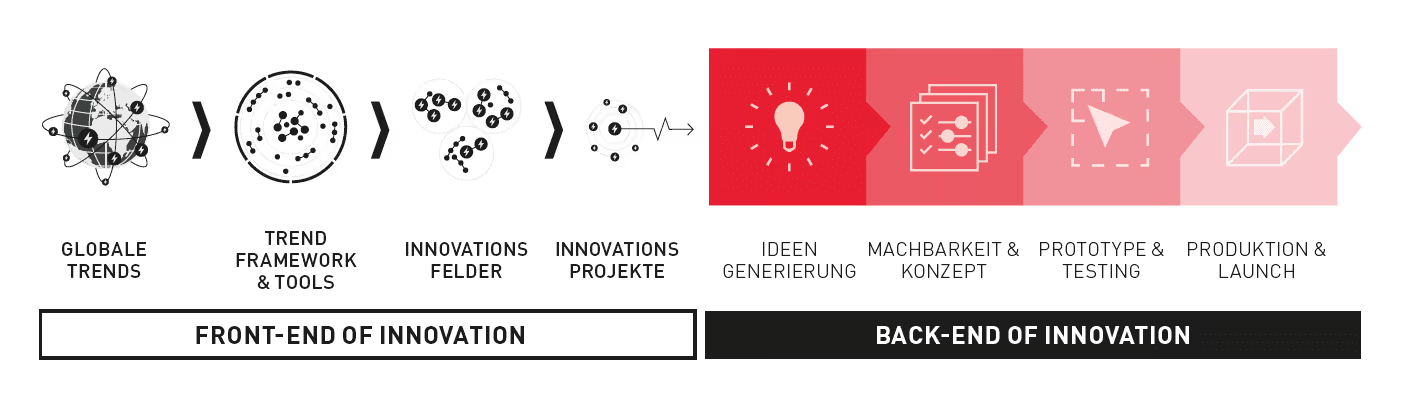
If you want to measure innovation, you should focus on the very beginning of the innovation process. In the so-called "Fuzzy Front End of Innovation", you still have the chance to orient yourself: where exactly do I want my innovation activity to take me? Before classic innovation management, you identify relevant changes through systematic trend management that provide important impulses for your innovation work.
Every company that engages with trends in the Fuzzy Front End of Innovation goes through several steps with different levels of effort – depending on the company’s size, its specific innovation goals and the stakeholders involved.
Choose KPIs for the Fuzzy Front End that are tailored to your innovation strategy so that you steer your innovation activities in the right direction from the start. In doing so you create impact in the subsequent Back End of Innovation, strengthening your company’s innovation capability and ultimately determining whether an innovation successfully reaches market readiness.
Whitepaper: Innovation Is Measurable
The TRENDONE whitepaper "Innovation Is Measurable" reveals the 10 most important KPIs in trend and innovation management.
Innovation KPIs help you assess your success, serve as a strong communication tool, and underline the importance of trends and innovation within your company.