
It has never been easier to stay informed about trends and innovations on a daily basis. Digitalization is creating a flood of new impressions and ideas. For us as trend researchers, it has long ceased to be enough to simply ask what is new. Instead, we analyze what the new actually means for individual industries and how companies can apply such transformation phenomena. So above all, it is about the question: how do I get from trends to innovation?
Understanding and applying trends correctly
Some companies only look at the technical component behind a trend. They then jump to the conclusion that the trend is irrelevant for them because the technology does not (yet) appear feasible. But if the focus is on the socio-economic shifts, you realize that your own business environment is affected, too—whether through changed customer needs or shifts in employee behavior.
The ability to understand trends and derive implications has therefore become a success criterion. New business models, products, and services can only be created when the trends relevant to the company are selected and their effects are correctly decoded. As trend researchers and innovation consultants, we help companies broaden their perspective.
A Trend Radar helps with identifying and integrating trends
Identifying relevant trends early and then incorporating them into the innovation strategy can be a competitive advantage. TRENDONE has developed various methods to help companies engage with trends and sharpen their perception. One of these is the Trend Radar. The Trend Radar helps companies identify trends early and systematically integrate them into their innovation strategy.
A Trend Radar can perform a wide variety of functions in a company. It can be a strategy tool, a decision-making tool, a communication tool, and an innovation tool—and it can capture the mood of the workforce. A Trend Radar helps to process the flood of trends and to focus strategically. It eases the decision for and against trends and creates prioritization.
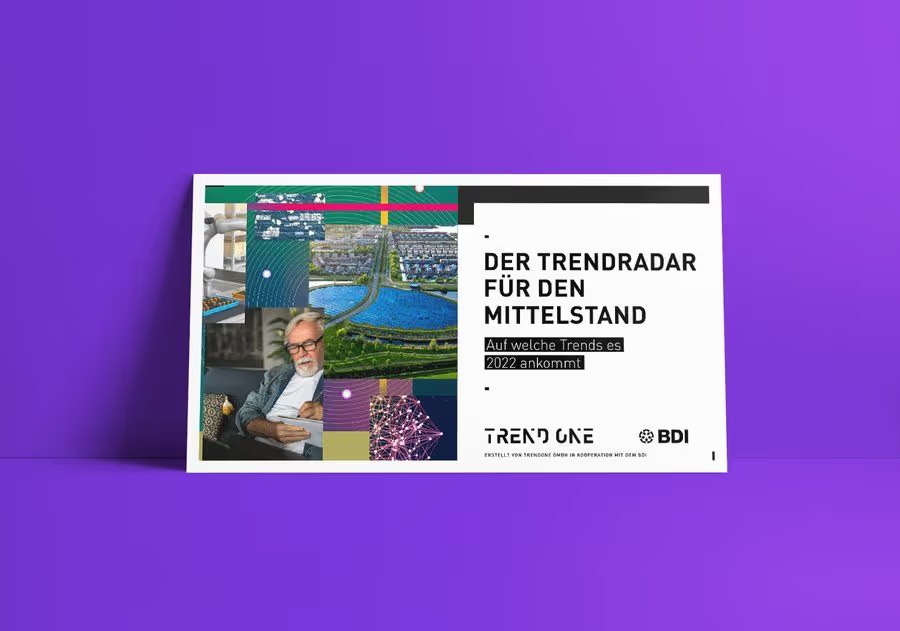
The Trend Radar for the Mittelstand
With the Trend Radar for the Mittelstand, TRENDONE—together with the BDI (Federation of German Industries)—provides a data-driven answer to the question of which trends are most relevant for the Mittelstand in the DACH region.
Working successfully with trends requires a culture of innovation
In the end, trends—properly understood and applied—can be the catalyst for a shift in corporate culture toward a culture of innovation. For that to happen, trends must become an essential part of innovation management. Innovation structures need to be in place in the company before the first idea is developed. The worst thing that can happen is the "filing away" of innovative ideas because afterwards no one feels responsible for taking them further.
Before kicking off an innovation project, companies therefore need to set the stage and ask themselves: who looks for ideas? Who develops them further? Which existing structures in the company are used for further development? Where do new development structures need to be set up? Which hierarchical levels and stakeholders must be involved at the different stages of development?
From trends to innovation
Trends describe developments in very different areas. For that reason, trends can support a holistic innovation approach that reaches far beyond the horizon of individual industries—starting with the components of people, technology, and business, at whose intersection innovation emerges.
Alongside the external environment, looking at the innovation structures within the company is the second important piece. Often, innovation barriers hide here that need to be resolved first before an idea can be brought to market. As trend researchers and innovation consultants, we are by your side and develop tailored strategies to get you from trends to innovation.