

The ability to innovate is a key factor in a company's economic success. Without innovation, a company can hardly succeed in the long run.
But what exactly is innovation? And how can you make your organization innovative? What does professional innovation management actually mean, and which factors should you keep in mind to innovate successfully?
Here you will find everything you need to know about innovation and which factors are decisive for success in your company.

What is innovation?
There are countless definitions of the term innovation. What all definitions share is that innovation is always about:
- creating something new or improving something existing
- creating value and serving a market
The word "innovation" originally derives from the Latin verb innovare and literally means "renewal" or "novelty." So it is mainly about creating something new.
An innovation can emerge through the further development of existing ideas or concepts or through the creation of something entirely new.
Innovation is the process of developing and introducing something new, or improving existing products, services, processes, or business models. Innovation is about creating new value and unlocking the potential of ideas to meet customer needs and gain competitive advantage.
5 reasons why innovation is critical for your company
Here are five reasons why you, too, should bet on innovation in your company:
Sources of innovation: how can companies systematically find inspiration and ideas for innovation?
Innovation is essential today if you want to stay successful in the market over the long term. But where can you draw inspiration to spark innovation?
To develop new and innovative ideas, the following sources can serve as inspiration:
- 1Customer feedback and needs: By analyzing customer feedback, companies can find out what problems and needs their customers have and develop ideas for innovations that could better solve them.
- 2Competitor observation and analysis: Observing and analyzing competitors can help generate new ideas for products or services that differ from those of the competition.
- 3Employee ideas and suggestions: Employees can be a valuable source of innovation. Companies should encourage their employees to develop ideas and suggestions for new products or services and foster an open culture of innovation.
- 4Technological developments and trends: Technological developments and trends can help companies develop new products or services that meet customer needs.
- 5Research and development (R&D): Research and development is an important source of innovation. Through R&D, companies can develop new technologies and products that can revolutionize the market.
- 6Cooperation and partnerships: Cooperation and partnerships can help companies develop new ideas and innovations. By collaborating with other companies or organizations, companies can develop new technologies and products.
- 7Industry associations, trade journals: Industry associations and trade journals can help companies stay up to date on technology and trends. Companies should use these sources to develop new ideas and innovations.
- 8Crowdsourcing and open innovation: Crowdsourcing and open innovation are innovative approaches in which companies collect ideas and suggestions from a broad audience. It is also an interesting source of ideas and innovation.
- 9Market research and trend analyses: Market research and trend analyses can help companies understand customer needs and wishes better.
Use these sources to adapt your products and services to the market's needs, spot trends early, and prepare for them calmly.
Incremental vs. disruptive innovation
Generally, we distinguish innovations by the extent of the change involved. We don't only speak of innovation when something completely new has been invented.
The most important forms of innovation are disruptive and incremental innovation.
Incremental innovation
We speak of incremental innovation when there is gradual improvement of existing products, processes, or services. It is a gradual and continuous optimization of product design, quality, performance, or usability.
A typical example is the continuous improvement of smartphones from generation to generation, with new features and improvements added each year to enhance the user experience.
Disruptive innovation
A disruptive innovation is an innovation so novel that it fundamentally changes existing industries or creates entirely new markets. Disruptive innovations revolutionize the market and shift customer expectations over the long term.
Netflix as an online streaming service is a good example of a disruptive innovation. Consumers can now stream on-demand content on their own devices, which challenges and changes the traditional TV model.
What forms of innovation are there?
We also distinguish different forms of innovation based on the area in which they are applied.

Product innovation
This type of innovation refers to the development of new or improved products or product features that better meet customer needs or address new ones.
Examples:
- Apple with the launch of the iPhone and iPad
- Tesla with its electric cars
- Nike with the continuous improvement of its sports shoes and apparel
Service innovation
This type of innovation stands for the development of new or improved services or the way services are delivered. Service innovations aim to increase customer value, improve customer satisfaction, and remain competitive.
Examples:
- Airbnb with its platform for renting out private accommodations
- Uber with its app-based ride-hailing service
- Spotify with its music streaming service
Technological innovation
Technological innovations are the development of new or improved technologies or the application of existing technologies in new ways. They can enable new products, services, or business models or improve the efficiency, quality, or flexibility of processes.
Examples:
- Google with its search engine technology and the launch of AI tools
- Microsoft with the launch of Windows and its cloud computing technology
- SpaceX with the development of reusable rockets and the mission to colonize Mars
Business model innovation
This type of innovation refers to the development of new business models or the adaptation of existing business models to create new opportunities or address challenges. Business model innovations can open up new revenue streams, reduce costs, or unlock new customer segments.
Examples:
- Netflix with its subscription model for video streaming
- Amazon with its online retail model and the Prime subscription model
- Uber with its ride-hailing business model
Marketing innovation
This type of innovation refers to the development of new strategies in terms of product design, packaging, advertising, pricing, distribution channels, or business models, in order to win new customers or reach existing ones better.
Examples:
- Red Bull with its focus on extreme sports events to associate its brand with adventure, adrenaline, and youthful energy.
- Amazon uses data-driven recommendation systems to create personalized shopping experiences for customers.
- Nike offers personalization technologies for sportswear and shoes.
Ecological innovation
Ecological innovations refer to the development of new or improved products, services, or technologies that are more ecologically sustainable or help solve environmental problems. They can contribute to reducing pollution, saving energy, or using resources sustainably.
Examples:
- Tesla with its electric cars and the promotion of renewable energy
- Ikea with the introduction of furniture made from sustainable materials and its commitment to a circular economy.
- The brand Ela Mo with its focus on the sustainable and environmentally friendly production of backpacks.
Social innovation
Social innovations refer to the development of new approaches to solving social or societal problems such as poverty, inequality, or environmental issues. They can be applied to governmental or non-governmental organizations.
Examples:
- TOMS is a shoe company committed to helping people in need in developing countries by donating a pair of shoes for every pair sold.
- Sozialhelden, which campaigns so that people with disabilities can participate equally in social life.
- The start-up MyMolo, which offers mobile housing units and engages socially by supporting homeless people with its housing units.
Systematically foster innovation through professional innovation management
Professional innovation management is based on a systematic process aimed at fostering and implementing innovation within the company.
With strong innovation management, you support your employees in unleashing their creativity, developing ideas, and—as a result—creating new or improved products or services. The goal is to ensure that your company's full innovation potential is unlocked—which ultimately is the key to sustainable success.
sTEP 1
Identifying innovation opportunities
Innovation management begins with the systematic collection of innovation ideas that enable the company to develop or improve new products, services, or business processes. This can be done through market research, customer feedback, competitive analysis, or other methods. It is very helpful to use software like the Trend Manager, which surfaces current trends while also enabling you to spark, document, and evaluate ideas internally.
sTEP 2
Evaluating innovation opportunities
The identified opportunities are then evaluated to determine which offer the best chance of being implemented successfully and giving the company a competitive advantage. Various factors are taken into account, such as market potential, resource requirements, risks, and technological feasibility.
sTEP 3
Developing innovation concepts
Based on the selected innovation opportunities, concepts are developed to turn the ideas into concrete products, services, or business processes. Ideas are sketched out, prototypes are created, and business plans are drawn up.
sTEP 4
Implementing innovation projects
After concept development, innovation projects are launched to put the ideas into practice. Resources are allocated, project teams are formed, and progress is monitored.
sTEP 5
Evaluation and optimization
Once projects are completed, the results are evaluated to measure the performance of innovation management. Success factors such as innovation rate, return on investment, customer acceptance, and employee satisfaction are analyzed. Based on the results, optimization recommendations are developed to continuously improve the innovation process.
Professional innovation management requires a high degree of commitment, creativity, and know-how.
This is where we can advise you and your company with our expertise and make sure your innovation process is on target and delivers the success you are looking for.
Our innovation software, the Trend Manager, is not only a helpful source of innovation thanks to its Trend Radar but also the tool of choice for steering innovation processes and measuring the success of your innovations.
How can the success of innovation be measured?
What are the relevant key performance indicators (KPIs) you can use to measure innovation?
It makes sense to first think through the following questions:
- Which goal or strategy should the KPIs support? Which metrics would help you move closer to your goal?
- What are the most important KPIs you should focus on? Here it is crucial to focus on the most important metrics rather than losing sight of the big picture with too many different KPIs.
Once the most important KPIs are defined, you can put fixed structures in place to regularly review, document, analyze, and communicate the metrics and propose actions.
In our free whitepaper "Innovation is Measurable," we present the 10 most important KPIs in trend and innovation management—so you can meaningfully measure the success of your innovation initiative from the start:
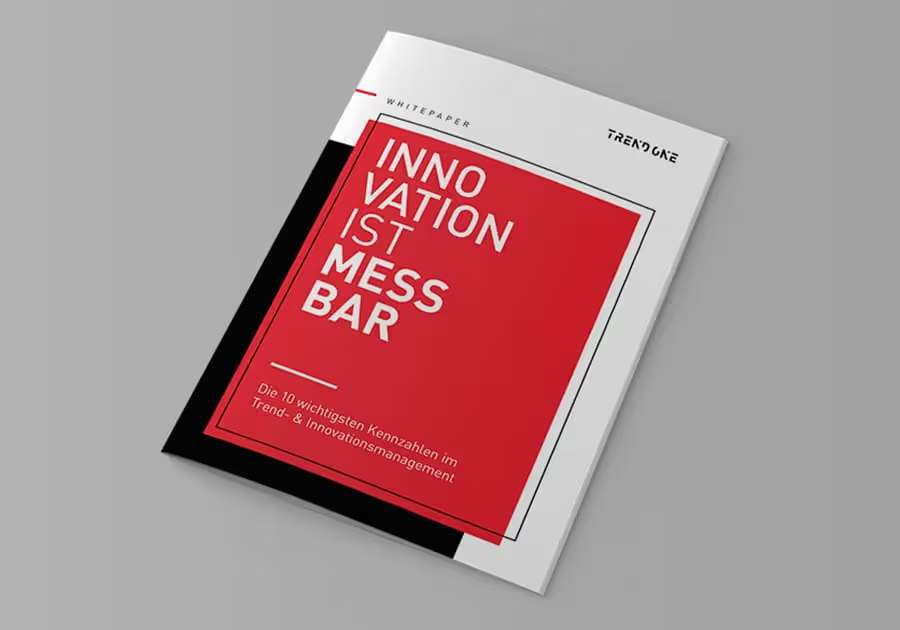
Whitepaper: Innovation Is Measurable
The TRENDONE whitepaper "Innovation is Measurable" lays out the 10 most important KPIs in trend and innovation management.
Innovation KPIs help you evaluate your success, serve as a strong communication tool, and demonstrate the importance of trends and innovation within your company.
10 success factors of innovative companies
When you try something new—whether it is an incremental or a disruptive innovation—you can celebrate magnificent successes or fail spectacularly.
Or as Ferdinand Piëch once put it:
"With innovation, a company always takes risks; without innovation, a company always perishes!"
These 10 factors are decisive for the success of your innovations.
- 1Clear innovation strategy: Define a clear innovation strategy that includes goals, resources, timelines, and expected outcomes.
- 2Customer-centric approach: Align your innovation efforts with the needs and wishes of your customers and actively involve them in the innovation process.
- 3Culture of innovation: Create an open, creative culture of innovation in your company. Tap into the collective intelligence of your employees by actively asking for their ideas.
- 4Talent management: Attract, retain, and develop talented, creative employees to maximize your company's innovation potential.
- 5Agile methods and structures: Use agile methods to respond quickly to change and innovate faster. Agile management fosters collaboration and knowledge sharing to drive innovation and accelerate the innovation process.
- 6Investment in research and development: Invest in research and development to create new products, processes, and technologies that keep you competitive.
- 7Networks and partnerships: Build connections. Exchange ideas with other companies and organizations and leverage networks and partnerships to develop new ideas and technologies and drive innovation.
- 8Measure and analyze: Track your progress and always keep an eye on your KPIs. That way you always know whether your innovation efforts are on the path to success and can adjust strategies at any time to reach your goals.
- 9Innovation budget: Companies that prioritize innovation must invest in their innovation efforts and provide a sufficient budget to develop and launch new products, technologies, and processes.
- 10Willingness to take risks: Have courage. Take risks and try new approaches. Try to see failure as part of your innovation process and act like a scientist: learn from it and try again in a different way.

The path to a future-ready innovation strategy
TRENDONE accompanies you and your innovation initiative—from the first impulse to a market-ready innovation.Take the first step toward a successful innovation strategy and book a free consulting call directly.