Which trends should mid-market companies focus on in particular? To answer this question, Senior Innovation Advisor Torsten Rehder—together with his team and in cooperation with the Federation of German Industries (BDI)—created the Trend Radar for the German Mittelstand. Alongside sustainability, New Work, and the platform economy, Torsten and his team identified a total of 6 Megatrends and 24 Macro Trends for the radar. They then conducted an online survey with more than 150 innovation leaders from 12 industries to gather their assessments. In this interview, Torsten reveals how well the Mittelstand is positioned to handle these trends and what innovation leaders in their companies can do to close existing competency gaps.

The Mittelstand carries great responsibility and closeness when it comes to employees, customers, and business partners. What is often missing, however, is a systematic early-warning system.
Torsten Rehder - SENIOR INNOVATION ADVISOR AT TRENDONE
Why did you focus your analysis on the Mittelstand?
Torsten Rehder: The Mittelstand comprises more than 99 percent of all companies in Germany. They generate more than half of the country's value creation. People talk internationally about the "German Mittelstand." 60 percent of jobs are based in the Mittelstand. It is also a key part of our vocational training system. 82 percent of company-based apprenticeship positions come from the Mittelstand.
Which major Megatrends did you identify as relevant?
Torsten Rehder: The trends for the Mittelstand that are tied to major challenges. The biggest is digitalization. That is why digitalization itself appears as a Megatrend. Added to that are topics influenced by digitalization, such as the so-called Data Era, which continuously produces and provides data as a new raw material. Another major challenge is, of course, the skills shortage. An important Megatrend here is automation: can certain value-chain steps be handled without skilled labor? New Work also plays a big role: how can I be attractive on the labor market and use further training and qualification to address the skills shortage myself, rather than always waiting for the education system? Then we have the platform economy as a very market-side response to digitalization. Finally, there is the Megatrend of sustainability—which essentially ushers in the next growth cycle, one shaped not by exploitation but by intelligent and sustainable use of our resources. We are talking about growing environmental markets, health markets, nano-biotechnology, nutrition. These are all topics that will define the next growth phase globally and in Germany.
Sustainability is a paradigm that has moved into public focus. Which Macro Trends in sustainability are relevant for the Mittelstand?
Torsten Rehder: The circular economy, for example. Through it, companies can make an important contribution to achieving climate goals. After use, products should not become waste, so that secondary raw materials flow back into production. Sustainable product design is key here. Another important trend is the topic of eco materials—sustainable materials. Plastic packaging is a major problem. People are looking at alternatives, perhaps renewable materials that are not, like plastic, based on crude oil. We also have the topic of cleantech: how is the primary energy that we need for making products actually generated? Can companies perhaps even produce their own energy to become more independent from electricity markets? The smart grid plays into this as well—an important cog in the broader sustainability trend. We are currently overhauling our entire energy supply system. It is open-heart surgery, and it only works if we take into account decentralized power generation options. An intelligent grid will have to set certain priorities, so that machines run in every household and business, cars can be charged, and our TVs still have power.
A Trend Radar breaks broad Megatrends like sustainability down into concrete Macro Trends. What were the criteria for evaluating the 24 Macro Trends?
Torsten Rehder: This time, we surveyed three criteria. Two are fundamental for creating a Trend Radar. They are the basic criteria we always ask about: first, how strong the trend's impact is on your own company. Second, the timing—that is, when the majority of market players in an industry will adopt the trend. Will it take another two, three, or four years, or longer than ten? When a trend diffuses into the mainstream, you need to be on board by then at the latest, or you will fall behind. Finally, we asked about a third criterion—competence: how well do you think your company is prepared for this trend? That was also very interesting, because here it is about self-assessment: would this trend hit us hard because we have hardly any in-house competencies? By surveying this criterion, we were able to surface certain gaps.
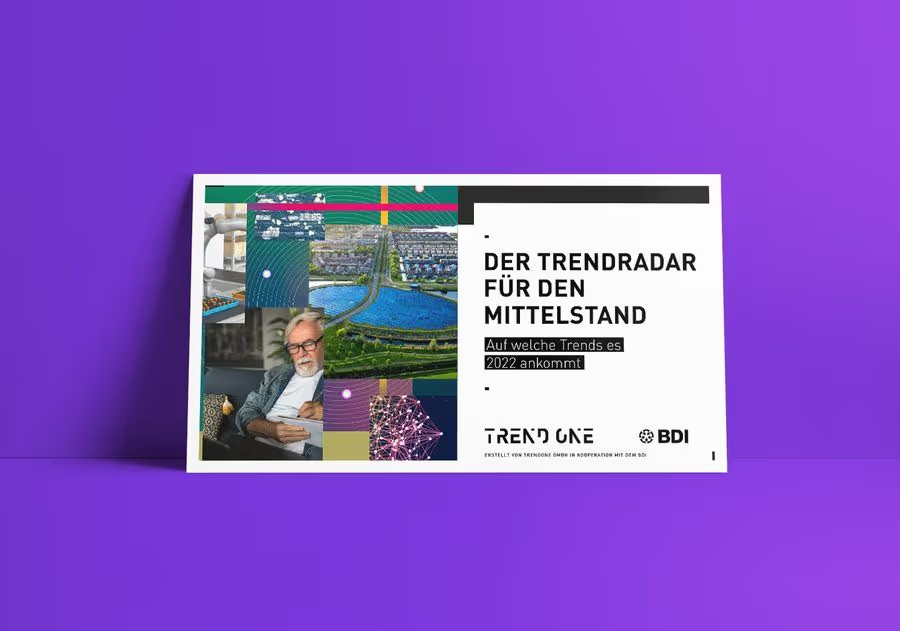
The Trend Radar for the Mittelstand
With the Trend Radar for the Mittelstand, TRENDONE—together with the BDI (Federation of German Industries)—provides a data-driven answer to the question of which trends are most relevant for the Mittelstand in the DACH region.
Which trends for the Mittelstand have the highest relevance and the closest time horizon?
Torsten Rehder: In first place among the top three Macro Trends for the Mittelstand is cybersecurity, which is not too surprising. For a long time, the Mittelstand thought that cyberattacks were aimed primarily at large companies because of their higher profile. There was also the assumption that attackers expected higher willingness to pay there—when a server gets hijacked and you have to buy your way out. But over the past three years, cyberattacks have increased sharply, especially in the Mittelstand, because small and medium-sized companies have often neglected their data security. In second place is the agile organization. Agile working structures, mindsets, and decision-making processes are spreading more and more in companies. The third trend is predictive analytics. This is about big-data analyses that simulate certain future developments such as demand fluctuations or production capacity in order to head off bottlenecks. You see this in many industries where I try to anticipate supply and demand or bring other process-relevant criteria from the future into the present. A simple example for retail: I run a bakery chain and can use predictive analytics to figure out how many caraway sticks I should produce for next Saturday, since a certain level of demand is highly likely.
Retail—and wholesale—is a good keyword. During the pandemic, we saw that when those channels fail, direct customer access becomes even more important. Is that one of the topics that made it onto the Trend Radar?
Torsten Rehder: The topic of "direct-to-consumer" is an important Macro Trend that landed in the "Act" zone. Since the COVID-induced lockdown at the latest, the trend has been soaring. If you are on Instagram, TikTok, or Facebook, you get the feeling that D2C brands—direct-to-consumer brands—are popping up like mushrooms, whether in fashion, body care, toys, or ice cream. Some of these are brands I cannot find at my local supermarket or discounter. I can only order them online directly. Direct sales, direct contact with the customer: there are many startups in this space. But you can also see that the classic Mittelstand player is moving strongly toward B2C and seeking the direct path to the customer. That is basically how they have always dealt with customers. Historically, the Mittelstand has had many long-standing, stable customer relationships and therefore always a direct relationship or direct sales channel. The trend plays right into the Mittelstand's hands. They just need to make the shift and pick up the new mechanics of the D2C trend.
Which trends did you notice that have a lower level of maturity or where relevance was rated lower? Were there any surprises for you?
Torsten Rehder: What struck me is that the Automation Megatrend has not a single trend in the "Act" zone. That surprised me a lot. The takeaway is that while automation can have revolutionary impact in the Mittelstand, the perceived need for action is currently still relatively low. Robotics in particular—which is quite advanced in some industries, for example among automotive suppliers—can bring important production steps back, because wage levels in Europe are too high. Robotics has particularly high growth rates in the context of cobots—robots that can work alongside humans rather than being separated in production halls. But participants in our survey didn't quite see it that way.
Surprising indeed. But many parts of manufacturing still happen in low-wage countries. The pressure to automate doesn't yet seem that high there.
Torsten Rehder: Intralogistics is, of course, a huge topic for automation. Especially semi-automated quality control is an important growth area. For "Made in Germany," quality control is a very important process step in the manufacturing industry. So far, the Mittelstand isn't fully recognizing the benefits of stronger automation in this area, but in the future, it will be a big topic. We should take a close look at why automation is rated so low compared to other trends. Sustainability trends have landed with companies. Circular economy and cleantech ended up in "Act" as well. That is where the future lies. But many sustainability topics don't work without digitalization and automation. You have to think about them together. Robotics, too, can contribute substantially to producing more sustainably.
You and your team have also extensively analyzed and interpreted the "New Work" topic. Which trends play a role here?
Torsten Rehder: One trend is called "Purpose Driven Organisations." It is becoming increasingly important to put purpose at the center of business activity and to send a signal to employees: why are we working in this company, with what underlying purpose? For many years, that wasn't seen as so important. The actual purpose was to make money and satisfy stakeholders. But the Mittelstand is doing very well here, especially family-owned companies with strong regional roots and a focus on local community—even though they are international players. Such companies have always carried their purpose with them, even if it was called something else.
Another important area is the Macro Trend "Re- and Upskilling," because we don't have a shortage of workers—we have a shortage of skills. The Mittelstand often leads the global market in specialized, technology-driven niches—the hidden champions you never hear of. They have a very high level of specialization, especially when it comes to technological expert knowledge. That isn't easily transferable from one company to another. If I move from a neighboring company, I can of course bring customer relationships and expert knowledge with me. But the half-life of that knowledge and its transferability is very limited—and getting more so. That makes internal training and continuing education important. Less for technology, and more for soft skills and basic competence in dealing with data. We call this "Data Literacy"—another Macro Trend. Likewise, basic competence in dealing with uncertain futures and other skills are becoming ever more relevant. It is up to the Mittelstand to pick these up through HR programs and set them up in a contemporary way.
The Trend Radar for the Mittelstand
With the Trend Radar for the Mittelstand, TRENDONE—together with the BDI (Federation of German Industries)—provides a data-driven answer to the question of which trends are most relevant for the Mittelstand in the DACH region.
How have innovation leaders from the Mittelstand assessed their own competencies in relation to trends?
Torsten Rehder: Generally speaking, the Mittelstand may have been a bit too hard on itself from an external perspective. The average competency scores ranged from 2.44 to 3.78 on a scale of up to 6. I believe they don't realize how much they actually know. The Mittelstand rated itself highest in cybersecurity. Agile and purpose-driven organization, as well as direct-to-consumer, were also rated quite high. You could say the good old virtues of the Mittelstand are reflected here: these companies innovate strongly from the customer need outward. You see this especially among suppliers. They innovate less through the possibilities of technology and more aligned with the customer's wishes. Many Mittelstand companies are also not in large metropolitan areas, but in places where you have to attract workers with incentive mechanisms first. But you can't solve everything with salary. What is important is offering modern working structures and the ability to balance work and family. These are all classic levers that the Mittelstand has always used.
Where does the Mittelstand currently have the least confidence? Among the lowest-rated trends for the Mittelstand are "Advanced Network Technologies." That includes 5G—actually a major potential area: as a company, I can build my own wireless network and connect machines with one another. But the market is very intransparent. Providers like Deutsche Telekom or Vodafone offer different programs. I am firmly convinced that we genuinely need 5G "at every milk can." For automation in particular, 5G is a key technology. Building competence here is therefore essential. Various initiatives must bring the topic closer to the Mittelstand and demonstrate its potential. Companies need the ability to set up pilot projects at low cost to see the benefits for themselves.
How well positioned do you see the Mittelstand when it comes to working with trends?
Torsten Rehder: When mid-market companies have understood the signs of the times, things move quickly. Ownership and management often lie in the same hands in the Mittelstand, especially in family businesses. And the stakeholder culture is rather manageable. All of this leads to short decision paths and fast decision-making. When it comes to agile organization, the Mittelstand is very far ahead. They have a great deal of responsibility and closeness when it comes to employees, customers, and business partners. What some companies might still be missing is the systematic integration of all this into an early-warning system. The Mittelstand can bring quite a lot to the table to build permanence in trend monitoring and future anticipation. But many Mittelstand companies are afraid of being saddled with a huge resource burden. It doesn't have to be that way. You can do trend management in a very large and broad way, but also very pragmatically and effectively with manageable resource investment.
The SME Trend Radar represents a cross-section and is therefore a good starting point for working with trends. Does it make a difference how the individual company evaluates the trends for itself?
Torsten Rehder: Absolutely. It is important to say that the real work only starts once I have a finished Trend Radar, because then I have to draw the right conclusions. Once I have prioritized the trends and know which ones to focus on and which I can wait another six months on, that is one thing. The other is: what does "Act" mean? What specifically do I have to do? What are the use cases and scenarios? Translating the radar into next steps is the most exciting part. Do the opportunities or risks outweigh each other here? Which area of the company is particularly affected? Is it a production trend? Does it primarily impact strategy or HR? From there, the relevant conclusions become more concrete, more specific, and more impactful for the company itself.
What should companies do if they want to build their own Trend Radar? What should they pay attention to?
Torsten Rehder: It is always important to consciously answer the question of why you need your own Trend Radar. I don't build a Trend Radar or work with trends just for the sake of working with trends. Trends are never an end in themselves. Where I want to go determines how I set up a Trend Radar. We had the search fields—the big slices of the pie. For us, those were the Megatrends. That isn't always the right scope. It is always about figuring out which purpose you are pursuing with that specific Trend Radar. Is it a Trend Radar with a technology focus, or one that aims to depict the world of change holistically, including social trends? From there, you derive the right search fields. The better the search fields, the better the results at the trend level. That is the first important step: define and prioritize goals. What are the main goals? After that, you align the content of the Trend Radar accordingly.
The second important point is to take the implementation context into account. How accustomed is the company in general to engaging with future topics? Many companies look at their past and analyze historical data. Then they act in real time, looking at what they need to do right now. Short-term orientation is fortunately less common in the Mittelstand than in publicly listed companies that have to think in quarters. We often have family-owned companies that think in generations and operate with a very long-term horizon. The implementation context still has to be considered. At the start, you shouldn't build a huge Trend Radar with 30, 40, or 50 trends. That is too much. It is better to start with a smaller version and use the company's learning effects to take it to the next level of complexity. So I know where I want to go and that things have to become more complex to deliver the full impact for the company. That is also an important goal—companies learning to engage systematically with the future and to draw conclusions.
Once you are on your way, you can think about which tools to use. A tool can make certain processes significantly easier from the start. If I have already built trend management that has become established, and then I look for the right tool, it gets difficult. Either I build it myself and it isn't affordable, or I look at what is available in the market from the outset.
Thank you for this insightful interview, Torsten.
Torsten Rehder: My pleasure. To close, I would like to issue a call—particularly to all Mittelstand companies: don't just download our analysis, but also share your feedback. Our work on the Trend Radar for the Mittelstand is an open process and always a basis for discussion. With that in mind, I look forward to the conversation. Thank you!