

Over the past decade, companies in the German-speaking region have grown increasingly willing to invest systematically in their future, a willingness that has been sharply accelerated by the crises of recent years. With it, the challenges facing innovation management teams are growing too.
We surveyed 85 innovation managers across a range of industries in the German-speaking region for their assessment. Our interviewees came from the fields of Innovation, Corporate & Business Development, Digital, Research & Development, and Product and Project Management. In every case, innovation managers face a mix of different challenges in their day-to-day work.
The ranking: Challenges in innovation management
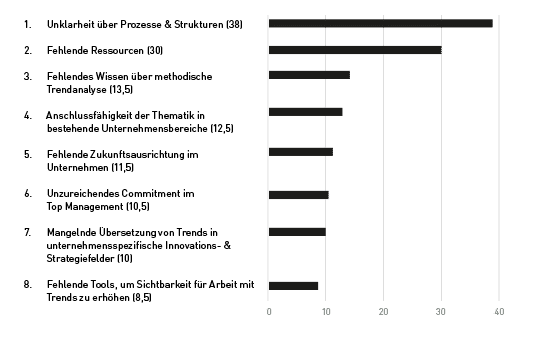
The ranking is topped by the diffuse feeling among innovation leads that future-relevant topics are difficult to get a grip on. They lack a clear picture of the company’s processes and structures.
This overload usually comes with a lack of resources – the combination of limited experience and limited time makes it difficult for many companies to put in place a solid initial framework for their innovation management. As soon as competitors launch innovative new products or strong campaigns, the internal pressure turns into external pressure.
A lack of future orientation in the corporate strategy is another key factor for innovation leads. Outdated business models and a lack of innovation culture in the company nip innovation efforts in the bud.
In many of the companies surveyed, awareness of the urgency of the topic has arrived, but those involved lack the methodological skills to act on it. Customer insights are often the decisive starting point for product innovations. What several survey respondents lack is an overarching, global view of trends beyond their own industry.
Whitepaper: Trend and Innovation Management
The TRENDONE whitepaper on trend and innovation management shows you how to successfully establish trend management in your company and how to professionalize innovation processes for the long term.
Translating trends into company-specific strategic fields bridges trend management and innovation management. It is precisely this bridge that several respondents lack, although for many of them the definition of future business fields is an obvious legitimation for introducing systematic trend management.
Our survey also showed that many innovation leads find the (communicative) transfer extremely difficult. Good communication and accessible language are required to inform the very heterogeneous interest groups inside the company and to ensure that content connects with them. Above all, the topic must be present and a clear priority at the executive level. One thing is clear: where future topics lack relevance, the company also lacks a compelling future vision.
One thing is clear: where future topics lack relevance, the company also lacks a compelling future vision.
Innovation management 2023 – What innovation teams should prepare for
- Rising complexity in trend topics
- Volatile markets and economic instability
- A lack of innovation mindset among employees
- A "War for Innovation Talent" (specialists who can deliver technological innovations)
- Budget and resource shortages for tackling disruptive innovations
– these are just five aspects that clearly show how innovation leads face enormous challenges. Many companies, from corporations to mid-market players, can no longer afford high innovation budgets and extensive exploration phases given the economic situation. Yet leaving the comfort zone is essential for companies in changing industries if they want to push forward "real innovations" that go beyond the current core business.
Innovation management plays a decisive role in a company’s future readiness. Many companies have successfully built up innovation teams or innovation hubs. They work best in symbiosis with leadership, corporate strategy and business development, keeping an eye on the trends that matter, monitoring idea management where relevant, and steering innovation projects from initial idea through to product development.
Based on our experience in innovation consulting, the challenge for innovation teams going forward will lie in embedding an innovation mindset across the entire company. Innovation is not a function that happens only in innovation teams or shows up only in their processes. Rather, innovation must become a guiding mindset for every employee in the company. The keyword Employer Branding, thought through from an innovation management perspective, could be a key lever and positive turning point for many companies in 2023. Anyone who wants to stay up to date on current trends or dive deeper into the practical mechanics of innovation management is welcome to sign up for one of our upcoming sessions.
WEBINAR