The circular economy is one of the most important trends of the 21st century – one that companies should pay particular attention to. Resource scarcity and climate change give the trend a high level of strategic importance. Both the rising awareness of sustainability across society and current and future climate and environmental policy are creating new requirements for the market. Companies should ask themselves how they can integrate the sustainable use of raw materials into their business processes in order to secure long-term competitive advantage.
Why the old throwaway economy has had its day
Our economic system is currently based on a linear model. We produce things, we use them, and then we dispose of them: Take-Make-Waste. The problem is that, on average, goods lose 75 percent of their raw-material value after a single use cycle. We use resources in a highly inefficient way and produce a great deal of waste in the process. A large share of it cannot be recycled. The consequence: enormous costs for people and the environment. On top of this, our resources are becoming ever scarcer while the world’s population continues to grow. The linear Take-Make-Waste model is already reaching its limits.
The circular economy is a complete system change
In contrast stands the circular economy. It aims to decouple economic growth from resource consumption. In an ideal circular economy, there is no waste. There is no longer any need for primary raw materials, because the lifespan of goods and materials is extended – ideally indefinitely – through upgrading, repair, refurbishment or smart product design. Crucially, we need to be able to break down products and everything we produce back into their individual components later on. Ideally, by material, with as little loss of quality as possible and minimal emissions. The circular economy is therefore something of a complete system change. The goal is a system in which things are no longer produced to be thrown away after use, but to remain in circulation for as long as possible and to keep generating value while doing so.

It is essential that we are able to break down products and everything we produce back into their individual components later on.
Companies can benefit from a circular economy because it makes them less dependent on raw-material imports, for example. Supply-chain bottlenecks, like those currently affecting manufacturing industries, would become a thing of the past. But how realistic is such a system? On the path to a true circular economy, there is a great deal to consider. Companies must keep the entire chain in mind – from sourcing materials, through transport, storage and production, to marketing and sales. Everything revolves around the most important question of what happens afterwards: how do we get the product back so it can be disassembled? How do we give consumers the information they need to dispose of or recycle it correctly?

Micro Trend
Repair your smartphone and computer yourself
Technology corporation Apple is selling individual parts and tools to end users. They also receive the necessary instructions to repair Apple devices such as smartphones and computers themselves. This means users can …
Initiator:
Apple Inc.
Country:
USA
Why is the circular economy so important in 2022?
In the trend toward a circular economy, two forces are colliding and reinforcing one another. On one side, the Market Pull concerns consumer behavior. Demand for recycled products is steadily rising, in step with growing awareness of environmental issues and the climate crisis. Consumers are demanding solutions from companies. We all sense that things cannot continue as they are. On the other side is the Technology Push: recycling processes driven by technology and continuously optimized, enabling us to bring important materials such as metals from electronic waste back into circulation.
Consumers are demanding solutions from companies. We all sense that things cannot continue as they are.
One of the key raw materials by which the technological success of the circular economy will be measured is plastic. Used in countless applications, it has special properties that are hard to replicate. But here too there are already alternative solutions, especially for product packaging or clothing. They include the breakdown of plastic or mixed textiles using enzymes. Artificial intelligence also plays a role: it helps identify individual materials and enables fully autonomous and as-pure-as-possible waste separation. Many fascinating individual innovations will arise along the supply chain – all of which will ultimately need to interlock at the end.
Micro Trend
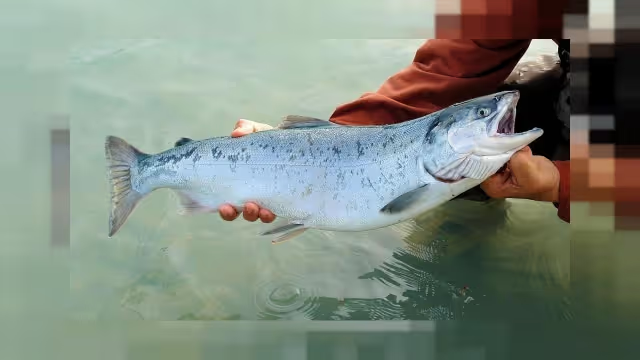
Eco-friendly plastic made from salmon sperm
Researchers at Tianjin University have developed an environmentally friendly plastic made from salmon sperm. The researchers isolated two short DNA strands from the fish’s sperm. They then mixed them with …
Initiator:
Tianjin University
Country:
China
Almost every industry must take action
The circular economy is a trend that plays a role in virtually every industry, and will play an ever-greater one. On the one hand, it is relevant for all energy- and raw-material-intensive sectors on their journey toward sustainable business. This applies, for example, to the construction industry, the electronics industry and also the fashion industry, which according to the UN is the second-largest environmental polluter. The fast-fashion model still dominates there – the absolute opposite of the circular economy. Each year, around 100 billion items of clothing are produced, of which only about ten percent are recycled. The rest creates 2.1 billion tonnes of waste. But several fashion and textile retailers are also pushing for new types of design or for the construction of recycling machines.
According to the UN, the fashion industry is the second-largest environmental polluter. The fast-fashion model still dominates there – the absolute opposite of the circular economy.
On the other hand, sectors where technological recycling innovation takes place are gaining importance – the entire waste management field, for example. Many new start-ups are entering this space and asking, for instance, how the materials inside batteries can be brought back into circulation, or how plastic waste from the ocean can be turned back into raw materials or energy sources. The food industry, too, must face the enormous volume of food waste and pursue intelligent reuse.
Micro Trend
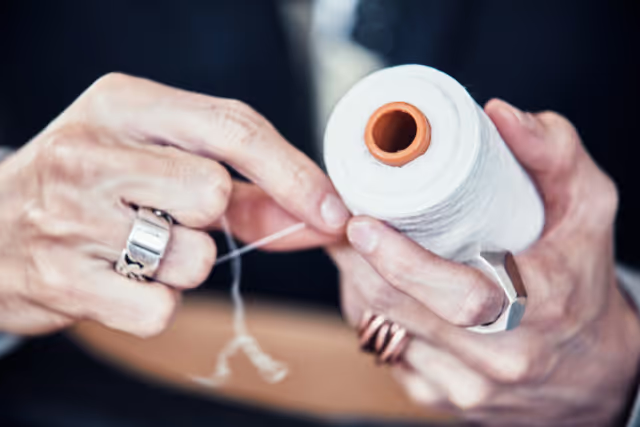
Meltable yarn for recycling textiles
The Belgian start-up Resortecs has developed a yarn that melts when exposed to heat. It is designed to help recycle textiles. This could cut the CO2 emissions of the fashion industry by 50 percent. The special yarn loses its properties at extremely high temperatures …
Initiator:
Resortecs
Country:
Belgium
The circular economy cannot succeed alone
To ensure meaningful recycling, producers will in future have to rely much more heavily on transparency and partnerships. It must be clear what is inside products so they can be disposed of correctly later on. This requires an open flow of information along the entire production and supply chain. Initial initiatives for this kind of networking between companies for better recycling can already be seen in the textile sector. Just as important as looking beyond the boundaries of one’s own company is the look inwards at one’s own employees: training in the proper disposal of production waste, for example, plays its part in making the circular economy a success.
TRENDMANAGER
Your edge in working with trends
With the Trendmanager you create the substantive foundation for strategically grounded innovation.