

Camille Zimmermann, Director TRENDONE Switzerland, on the significance of AI for our world of work. The article first appeared in the AI Handbook published by trendreport.de.
Hardly any topic preoccupies corporations as much as AI. Expectations may sometimes be too high, but it is one of the most relevant megatrends of our time. AI systems have existed for some time, but rapid technological development now makes it possible to unlock their full potential.
Robots and AI systems are entering every sector of the economy, and the embodiment of artificial intelligence is advancing further. As a result, AI is becoming ever more visible and perceptible across different fields of application.
In the first industrial revolution, the steam engine replaced human muscle power; now AI is on the verge of replacing the human brain. Industrial revolutions have always fundamentally transformed life and living conditions. But the fourth industrial revolution is not unfolding linearly – it is advancing at exponential speed, and growing automation is already producing enormous changes in the way we work.
The economic reasoning seems clear: as soon as an intelligent robot is cheaper than a human worker, the human is replaced. A widely cited Oxford study speaks of an automation potential of 47 percent of all employees in the USA over a period of 10 to 20 years. This assessment is highly contested, however, and some experts believe that humans will not run out of work – quite the opposite. Experts do agree, however, that the nature of work will change and that organizations within companies will be fundamentally transformed.
AI raises fundamental questions for the organization of the future
For a long time, automation was invisible; but increasingly, robots are moving with apparent intent through human living and working spaces. How will people inside companies react to robots and artificial intelligence when a fundamental change in their workplace – or even the loss of their job – looms? A look at the past shows what kind of negative consequences and impacts are possible. In early 19th-century England, Luddism emerged. The Luddites fought against the industrial revolution and destroyed numerous spinning mills in the textile industry.
Current research shows how strongly people today react to the combination of robots and AI. People are worried, sometimes even angry, and – when directly affected – occasionally respond with sabotage. Companies therefore need to consider how they prepare their organizations and employees for the modern human–machine setup, because the introduction of visible AI brings radical changes to the organizational structure. The traditional boundaries between humans and machines are increasingly disappearing.
This raises the question of the success factors for optimal cooperation between humans and machines. What role does acceptance play, and how can it be actively promoted? How can the machine, and how can the human, be prepared for optimal cooperation? The image of AI and robotics plays a decisive role in this.
AI’s poor image is hindering successful adoption
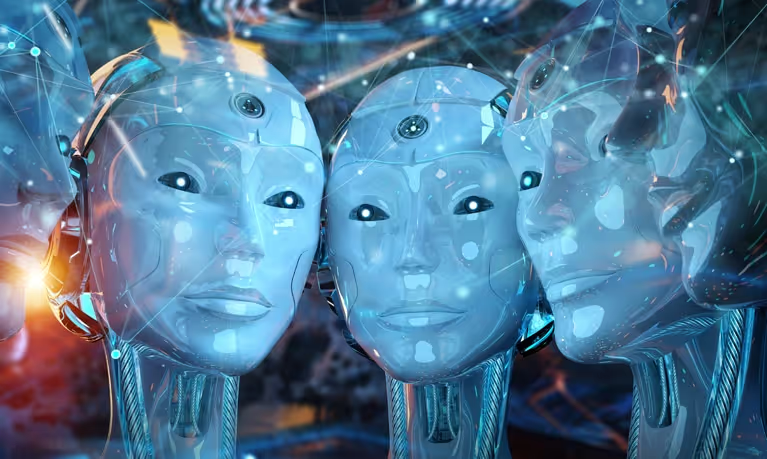
The image of AI and robotics is largely negative. Just as the film series "Jaws" lastingly shaped people’s perception of the ocean dweller in a negative way, the same is happening with AI and robotics. Science fiction films and literature paint a bleak picture for people when it comes to robots and AI: machines seize power and rise up against humanity. The struggle of machine against human takes shape in society. AI competitions in chess, backgammon, Jeopardy! and Go reinforce this perception. In people’s minds it is a battle against the machine that humanity is increasingly losing.
AI is also a hot topic for newspapers, TV channels and news portals. Almost weekly, new studies are published with horror scenarios about job losses due to robots and AI – and they attract a lot of attention. This fearmongering has its effect and unsettles workers.
In addition, the term "artificial intelligence" is misleading and is another source of mistaken perception. The term "machine intelligence" would be more apt and less misleading. The label "artificial intelligence" implies that we are trying to copy human intelligence and, ultimately, to replace it. This poor image is unjustified, but deeply rooted in people’s minds. For companies, it is crucial to overcome this mindset and these fears among their employees. They will only succeed if they put the advantages first, involve employees and ensure full transparency when deploying AI.
The debate around singularity is intriguing, but unproductive
Technological singularity is an exciting topic, but it neither helps the image of AI nor is it useful for the current debate. The question of singularity puts the issue of controlling AI directly at the center of the debate and reinforces the "human versus machine" mindset. It would be much more useful to keep an eye on the people and companies that are programming and shaping AI today.

The situation is absurd: companies rely more and more on technology and risk losing their humanity. At the same time, they try to make the machines as human-like as possible.
Camille Zimmermann – Director TRENDONE Switzerland
AI is an important part of robotics – the interplay of shell and core matters. AI and robotics will develop at different speeds over the next few years. AI is likely to evolve faster than robotics. In the short to medium term, invisible AI will therefore be far more relevant to the next development phase than visible AI. Robotics is much more complex and is several more years behind the development of AI. A temporal distinction is therefore appropriate.
Ensure transparency and foster acceptance
Transparency is one of the key factors. Companies must make clear at all times where AI is being deployed and for what reasons. This applies especially to invisible AI. People – both employees and customers – want to know at any moment when they are interacting with a machine. The division of tasks, the decision-making process and the underlying data must also be transparent. This is increasingly a challenge, because the way AI operates is becoming ever harder to understand.
Acceptance is another decisive factor. Without acceptance, there is no successful human–machine organization and no successful, profitable deployment of intelligent machines.
AI and robotics are best embraced and accepted by employees when they see personal benefits and their working situation improves as a result. From this, further recommendations for adoption follow. Company leadership is well advised to actively ask employees where they need support, where they would welcome the use of robots and AI, and what could be optimized with intelligent machines.
AI and robotics offer many benefits that employees should make their own – because then acceptance is at its highest. It is also useful for company leadership to assemble teams of people and intelligent machines and to let these teams manage and optimize the use of intelligent machines in ongoing comparison, until the coordination between human and machine delivers the best possible result and an individualized co-working setup is in place.
Humanoid robots should be abolished for now

A decisive point – and an important success factor – is the appropriate framing and handling of an intelligent machine. The robot and the AI must (at least for the next 20 years) primarily be regarded as a tool. This approach eliminates a host of issues at once: no inflated expectations, no ethical and moral dilemmas, no risk of rejection along the lines of the acceptance gap theory, and no fundamental changes inside the organization. The responsible decision-makers within companies should not give in to the urge to deploy human-like machines, because in most cases this is counterproductive.
Humanoid robots should, in the vast majority of cases, be abolished. This is a radical recommendation that will raise eyebrows. On closer inspection, however, the suggestion is sensible in many cases. The specialist literature plausibly explains why developers strive to make robots resemble humans. The pursuit of human-likeness is followed by many roboticists so that the interaction between human and machine can be as natural and spontaneous as possible.
Another reason is our working and living environment, which is designed for the human body, meaning that robots can use the same tools as humans. In practice, however, this is not useful in most cases. The acceptance gap theory (the uncanny valley effect) also recommends designing intelligent machines to be human-like only in exceptional cases.
The situation is absurd: companies rely more and more on technology and risk losing their humanity. At the same time, they try to build machines that are as human-like as possible, hoping to gain more acceptance from their employees and, above all, their customers. But this is not necessary, because current research shows that people personify and humanize machines of their own accord.
It may be helpful for people to identify with machines or to draw on a shared experience, but human-likeness is not strictly necessary. On the one hand, the risk of rejection (according to the acceptance gap theory) is too great; on the other, a humanoid form could create an unwanted dependence of humans on the machine.
We should put humans at the center, without humanizing the machines. The focus should instead be on the interface between human and machine.
Focus on the interface between human and machine
A person’s first contact with a machine always goes through a user interface. It can be a keyboard, a mouse, a touchscreen or a voice interface. The user interface is therefore the entry point for a human–machine organization, especially when intelligent machines with AI are treated as tools and positioned accordingly within the company.
Good user interfaces prevent frustration, lower inhibition thresholds, build trust and – ideally – are intuitive and adapted to human nature. With AI in use, new possibilities open up here. Companies aiming for an optimal symbiosis between human and machine should focus their development efforts on this area. Voice-based input, control and communication currently offer the greatest potential and may, for the first time, provide a truly natural user interface for humans interacting with machines.
Developers must ensure that machines adapt to humans, not the other way around. At the same time, humans must learn to deliberately hold back their unique skill – adaptability – so that intelligent machines can take this step.
The change is already well under way
People will become accustomed to using AI and robots, much as they did with the introduction of computers. Voice systems powered by AI will be the first to establish themselves and to give people a new, natural user interface.
This is the next logical wave of digitalization, and companies can and should learn from past mistakes – because for many companies this change is not new. Every change brings transformation, and every transformation brings resistance. But companies and their employees have no choice and must deal with it.
For company leaders, it makes sense to focus on the many opportunities and not be put off by the poor image of AI and robotics. Management should, however, be aware that this change is happening even faster than digitalization. Capabilities for working with AI must therefore be built quickly.
Non-use is also a form of rejection and sabotage, and it must be avoided within companies, because such behavior by employees can have undesirable economic consequences. On the one hand, intelligent machines cost a great deal to acquire; on the other, this behavior fails to leverage the potential of a symbiotic human–machine organization, putting the company at a competitive disadvantage.

Camille knows the opportunities of technological change
Camille Zimmermann conveys the value of trend-based consulting across all industries. Artificial intelligence is his specialty, particularly its impact on the future world of work. In his keynotes he weaves in aspects from leadership and change management.
This text is available under the Creative Commons Attribution-NoDerivatives 4.0 International license.
Original text: handbuch-ki.net/new-work-arbeiten-4-0/
Change made: "Megatrends" to "Mega-Trends".