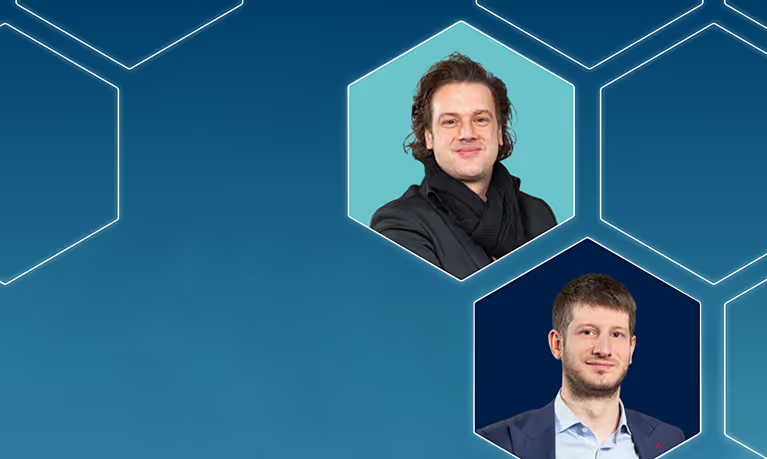
Everyone is talking about Industry 4.0 and total connectivity. But where do we really stand, where is global connectivity heading, and how are companies tackling the challenges that come with it? TRENDONE CEO Nils Müller and Sven Taubert, Head of Corporate Foresight & Market Intelligence at Lufthansa Technik, share their answers.
Industry 4.0 and connectivity are considered the megatrends of our time. What role does digital connectivity play in trend research?
Nils Müller: For us, Industry 4.0 – digital connectivity – is actually old news. The development process is far from complete, and not even at every company, but the trend is also no longer particularly new. In trend research we are already engaging with trends like the Web of Thoughts, the Bio Web or Super Intelligence.
How far has digital connectivity actually reached companies?
Nils Müller: That’s difficult to answer in a blanket way. In general, however, it can be said that digital connectivity plays barely a role at many SMEs, while large industrial corporations have at least put one or two measures in place. But even there, full connectivity is nowhere in sight.
But aren’t more and more companies putting a great deal of energy into this topic?
Nils Müller: On the surface, yes. But Industry 4.0 as a megatrend places the networking of every product, process and facility on many companies’ agendas. On the basis of cyber-physical systems, mechanics and software are to merge, and required data is to be exchanged wirelessly. But connectivity in the context of Industry 4.0 goes far beyond the factory floor. It integrates customers, business partners and processes into a central web- or cloud-based platform. I currently see all of this happening only at a few companies in a select few industries.
Sven Taubert: That is also true for us at Lufthansa Technik. We also look closely at every trend. And we see great potential in many of these trends, including in digital connectivity. But technologies must always be extremely intelligent and flexible to be a good fit for us. There is no point chasing every tech trend just because it is fancy. For highly individualized work, every technology must be practicable, applicable and offer recognizable value. From our experience, only a handful of tech trends from other industries are truly relevant for us so far. Sometimes I have the impression that there are fundamentally more solutions than problems.

Connectivity in the context of Industry 4.0 goes far beyond the factory floor.
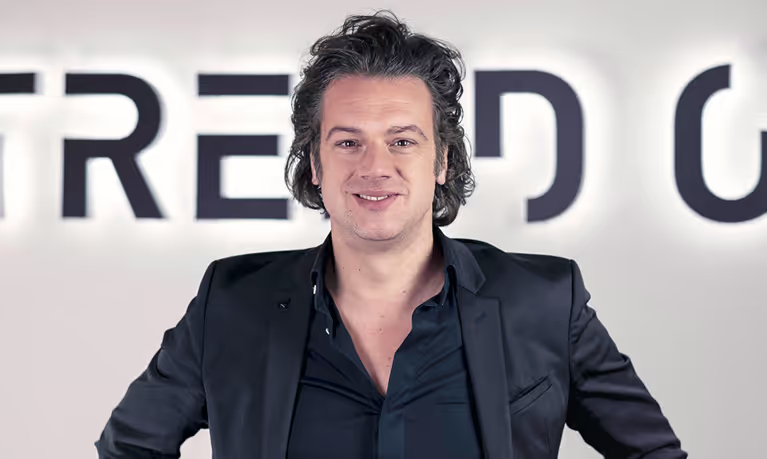
Nils Müller – CEO TRENDONE
And where in industry are there already concrete fields of application for such megatrends?
Nils Müller: In industry, particularly in the automotive sector, there have been many fields of application for megatrends for some years. This applies to engineering as well as to production. There is barely a manufacturer left that does not use modern production robots and automated guided vehicles or virtual and augmented reality applications. These are all trends that are also conceivable for aerospace industry applications.
Sven Taubert: We have also looked for fields of application in the past. But not all efforts have proven their worth over time. The virtual fit check in our CAVE, for example, we abandoned, while projection-based assembly support using augmented reality has prevailed.
But you also keep hearing about many new developments – for example, the first concrete flying taxis and other innovations.
Sven Taubert: Many of these technologies are genuinely trendy. But in most cases they are not finished products or prototypes – they are merely studies or demonstrators. On closer inspection, you quickly realize that they are either not yet mature or fully thought through, or that they still have to prove their suitability. Aviation simply plays by different rules. Because of long development cycles of up to ten years driven by strict safety requirements and laws, risks at product launch are absolutely off limits. With us, "safety first" applies, not "trial and error".
Which technologies – particularly when it comes to connectivity – are actually suitable for aviation?
Sven Taubert: Fundamentally, we have to distinguish between technologies we use as an industrial company and those we develop to offer our customers as products for their aircraft. In our product divisions we are well advanced in terms of machine connectivity. In the aircraft itself, however, the situation is different. Take "WAIC", Wireless Avionics Intra-Communications, a radio frequency approved for aviation by the World Radio Conference, which has the potential to read out smoke detectors, lighting and sensors in the airframe or in the engine. This system could easily be installed. But the test programs for such a development on an aircraft are extensive and lengthy. Worldwide certifications, complex approval procedures for the technology and globally harmonized standards also play a central role here.
What are the next big trends that will influence – or even shape – industrial development in the coming years?
Nils Müller: One of the coming megatrends is about intuitive interaction concepts, i.e. voice and thought control. With brain-computer interfaces as the next generation of human-technology interfaces, you can communicate with technology quickly, directly and easily. There are already fields of application in medicine, for example for people with speech or physical disabilities. But brain-computer interfaces will also be very useful in logistics and production in the future.
Fundamentally, we have to distinguish between technologies we use as an industrial company and those we develop to offer our customers as products for their aircraft.
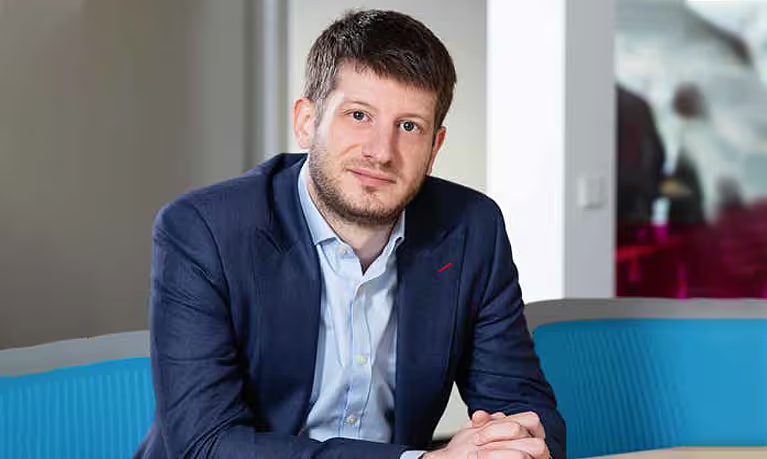
Sven Taubert – Head of Corporate Foresight & Market Intelligence, Lufthansa Technik
Sven Taubert: Voice control has also already arrived in our PD Engines. But I can also imagine us using this trend across several areas in ten years. What makes sense for us and will continue to gain ground are assistance systems that support and relieve our colleagues in production. Alongside this, the new 5G mobile standard, new software solutions and small mobile devices with high computing power will significantly increase flexibility and productivity in production. Not only will gigantic amounts of data become available, we will also run highly complex applications like CAD, simulations or predictive analytics in real time. These trends will significantly accelerate end-to-end connectivity and the digital transformation in production. The most important factor, however, remains our highly qualified workforce. For the vast majority of tasks in our industry, they are still better than any machine. If we manage to keep this lead through lifelong learning and let new technologies support us wherever it makes sense, we will continue to expand our market leadership in a connected future.

Nils Müller takes you on a journey into the future
In his captivating presentations, Nils Müller gives you a direct view of the future. Expect a fireworks display of fresh impressions, best practices and global trends. Of course, we will adapt all content to your needs together beforehand.