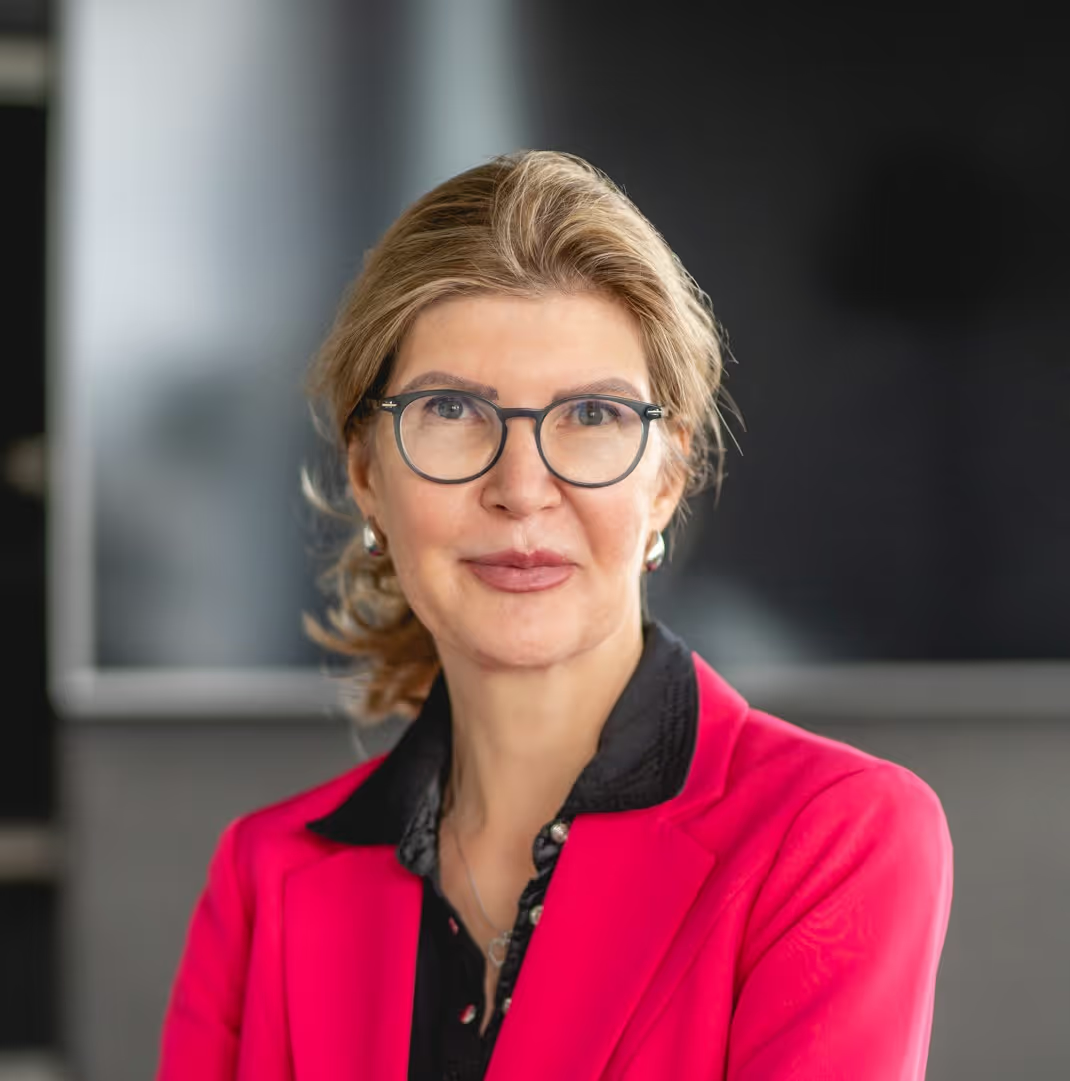
As a Senior Innovation Consultant at TRENDONE, Aileen is finding plenty of open ears on her mission to bring more future-shaping into companies. In this interview, she answered our questions on many compelling topics that matter deeply to her.
Dear Aileen, great to have you here! Your CV has a number of fascinating stations. Could you give us a short look back at your past?
Gladly! In recent years I have tried out many stations: from start-ups and corporates to consulting, and then I devoted myself to founding the non-profit educational organization "Die Zukunftsbauer" (The Future Builders). I don’t come from the education sector at all – I come from innovation – but after completing my Master’s in Futures Studies at FU Berlin, it became clear to me how absurd it is that a) I had never heard a word about the future, trends and innovation at school, and that b) I now had to spend my time in innovation projects with adults explaining how to allow yourself to think utopian, creative and bold thoughts – something we all carry inside us as children.
"Die Zukunftsbauer" was about how to bring the topic of "the future" into schools. We worked extensively with young people and let them design future worlds. I also engaged deeply with the topics of "non-profit work" and "social innovation in Germany".

It is absurd that I have to spend my time with adults explaining how to allow yourself to think utopian, creative and bold thoughts.
Aileen Moeck – Senior Innovation Consultant at TRENDONE

Companies have realized that without a "futures mindset" among their employees, it becomes difficult to actively shape the company’s future. In your view, where can and should companies start?
Technological progress and intense media coverage are currently giving many people and companies a sense of fixed future scenarios. At the same time, the perceived uncertainty is greater than ever. Whoever has the capital and the market power defines the future – or so it seems right now. The pressure to keep up drives many entrepreneurs to align their actions with the prevailing future narratives, regardless of whether this matches their own values or is sensible and sustainable economically and socially.
In order not to participate reactively in other people’s pictures of the future – and thus only ever chase innovations and trends – it is essential, alongside observing prevailing scenarios, to create a vision of one’s own future and to recognize this narrative as a space of possibility for innovation and one’s own future values.
For this, innovation needs to be lived differently in companies. So far, it is usually assigned to a specific department or only the decision-maker level. We need to get to a point where every individual in the company thinks innovatively. And that does not mean having an idea for a new product every day – it means a particular way of thinking and an attitude: being open to the new, being able to think in alternatives, taking a systemic view of things, but also being critical at times and, above all, proactive.
Self-efficacy is THE central attitude we need to become future-ready and resilient as individuals and to drive the Great Transformation forward as organizations.
Aileen Moeck – SENIOR INNOVATION CONSULTANT AT TRENDONE
A major problem of our modern society is – and our education system has played a decisive part in it – that we have become powerful consumers. We consume almost everything at the touch of a button: our democracy, work meetings, leisure, fashion, delivery services – we need to get back to taking matters into our own hands rather than letting things wash over us, to becoming self-effective.
That means: taking things into our own hands, getting in touch with our own feelings, or standing up for something. At first glance, that doesn’t seem to have much to do with the future, but it is THE central attitude we need to become future-ready and resilient as individuals and to drive the Great Transformation forward as organizations.
A conscious use of our imagination could help develop something that UNESCO defines as Futures Literacy. In English, literacy describes a set of knowledge, skills and attitudes that support the development of reading and writing. Where digital literacy, for example, is about developing a basic mental model for dealing with the digital, Futures Literacy describes a kind of futures alphabetization or future competence – you could also say: the ability to actively think about and shape the future.
Developing Futures Literacy does not mean training people to make better predictions. Rather, it means broadly activating the human imagination as a creative way to engage with the new, with change and with complexity. It should help us understand the consequences of our own actions early, by practicing not only anticipatory thinking but also systemic and critical thinking. As a mental early-warning system, the Futures Literacy triad of anticipation, reflection and imagination can help us recognize how our actions or an idea play out in other contexts or at other times. It is about the ability not just to actively and consciously anticipate, but to know, understand and deliberately choose between different anticipation systems and processes, depending on context and purpose.
"The future" no longer describes only what is coming tomorrow, but stands for an awareness that opens up entirely new spaces for thinking and acting.
"Futures thinking, future-shaping, futures awareness" – these are buzzwords that focus more on the "how", but for companies they are anything but a given. People focus heavily on the "what". How can these topics nevertheless find more space in project work? Do you have concrete tips for innovation decision-makers?
The basis of every innovation is courage, imagination and creativity. Companies need to establish a culture in which people can actively shape new spaces for action out of their own power. Only those who have a picture of themselves in the future can make decisions that enable them to act and adopt a positive attitude toward change. This is exactly where futures research comes in – and the ability to actively shape the future. Concretely, it can help to activate your own "futures muscle" before a project. We quickly get lost in linear thinking and the status quo.
There are many small exercises that help us broaden perspectives and look at things more systemically and over the long term. It also helps to put topics into context and, with every decision, bring the critic and the dreamer to the table and give "disruptors" enough space. Often it is only in this dialogue that new views of the existing emerge.
In innovation projects and trends, it then helps if we build a bridge to the individual by asking: what does this mean for my role or my department? Involving people is essential – and, where appropriate, also deriving new future roles instead of clinging to old job titles. That opens up new perspectives and, with them, new paths for companies. The "how" really should take up more space in everyday work. We have completely lost the ability to learn to think anew and to even reflect on why we think the way we do.