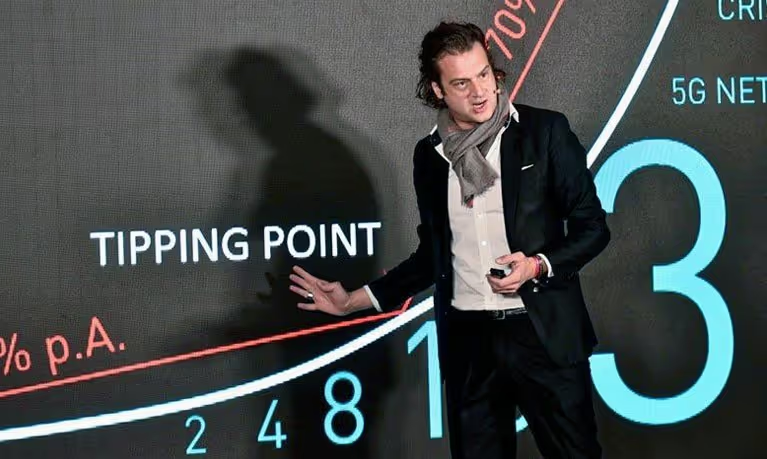
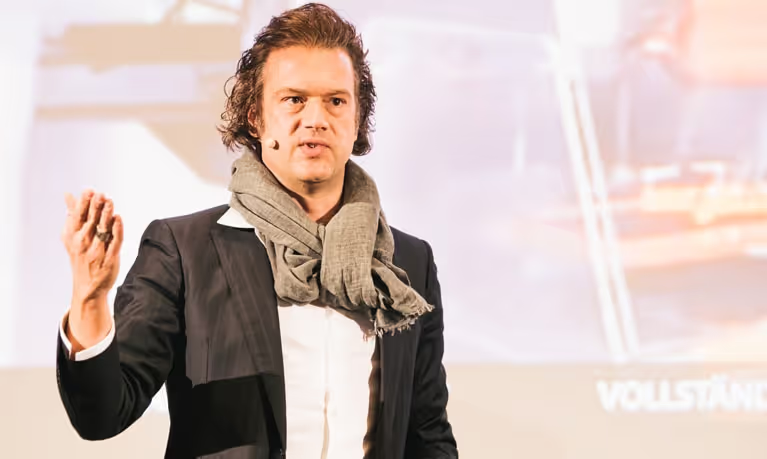
Disruptive ideas and radical technological advances are shaping our markets and our lives ever more strongly and broadly. In this interview, TRENDONE CEO Nils Müller explains how working systematically with trends can be an answer to the survival question facing companies. The text first appeared in Credit Suisse’s magazine Scope.
What fascinates you about trend research?
Many people are afraid of the future. They are influenced by reports in the media or by politicians warning of the imminent climate catastrophe or "the Chinese". But the future is something we can actively shape. So there is no need to be afraid of it. Trend research helps us understand the possibilities of the future and shape the 21st century as best we can.
Is thinking about the future a privilege of the intellectual elite?
No, the human brain enables us to think in scenarios. Everyone thinks about the future – even when it comes to simple questions of everyday life such as "What should I cook for my children?" or "How will I spend the evening?" What abilities are essential to research trends? Openness and the willingness to see and think the unknown – science-fiction thinking. Or put differently: the ability to speak with confidence about things that are not yet certain.
But then futurists quickly veer toward charlatanism…
Of course, the scientific foundation is missing here, because nobody really knows what the future will bring. But if I want to shape the future, I have to anticipate it. I have to believe in it. A good example is Elon Musk, who believes in electric mobility and builds Teslas. What matters is that trend research is paired with implementing innovation. The new trend research empowers people to act. The old school of trend research limited itself to talking about the future.
How do futurists go over with our engineers?
It varies. The German automotive industry, for example, has great engineers with a strongly developed problem-solving mindset. As a result, they tend toward incremental improvements. That won’t be enough. There is a lack of disruptive thinking. More entrepreneur, less engineer. We need more vision engineers.
Do we lack long-term thinking?
Yes, that is my view. Take China, for example. There, politics, business and science are aligned around goals that are pursued with discipline over the next 20 to 30 years. The Chinese also have the resources to do so. This ability to shape the future is a real power.
That may work well in authoritarian systems, but in Europe…
…the conditions are far more difficult. We have a debate culture without clear directives from the top, with a middle management that talks everything to death. But people in Europe also want to be able to orient themselves over the long term and have a vision.

More entrepreneur, less engineer.
Nils Müller – CEO TRENDONE
Should we be looking to the Chinese as a model?
Yes – to their impact, their speed and the funds they are putting into research and development, new technologies and start-ups. In Europe we need more risk capital, not just credit. Access to risk capital is also much easier in the USA.
What trends are emerging in education?
Learning and education are already no longer confined to fixed institutions. Through apps, online courses and virtual reality content, learning will, in future, take place independently of location, in multiple dimensions and throughout life.
What societal conditions need to be in place for edutainment offerings to truly spread?
Traditional education systems must evolve. Schools must be opened up to such offerings. Politicians are called on to massively promote them. Society must learn to accept that children spend time in virtual worlds. Today in Germany it is exactly the other way around. If children at kindergarten today mention they play Minecraft in the evening, they – or their parents – get sideways glances. In reality, Minecraft is exactly the world that prepares children for virtual environments and teaches them to find their way around there.
What are the technological drivers of edutainment?
Artificial intelligence (AI), virtual reality (VR) and scalability. The scalability of AI, for example, gives young people in Kenya the opportunity to take affordable online courses and study at Harvard University. As virtual reality spreads, such offerings will multiply massively. AI and VR will unleash huge scale effects not only in education but also in healthcare. AI and VR are on the cusp of going mainstream. The relevant applications will explode over the next ten years.
Which examples from healthcare are particularly striking?
In the USA, a mobile ultrasound scanner has been developed that is operated via an app on a smartphone. The app is AI-powered and enables anyone to perform an ultrasound examination without a doctor. The app then triages and only forwards unclear or problematic findings to the doctor. Thanks to the intelligent software, millions of people gain simple and affordable access to a medical diagnosis that would otherwise be denied to them because of inadequate medical care and a lack of infrastructure.
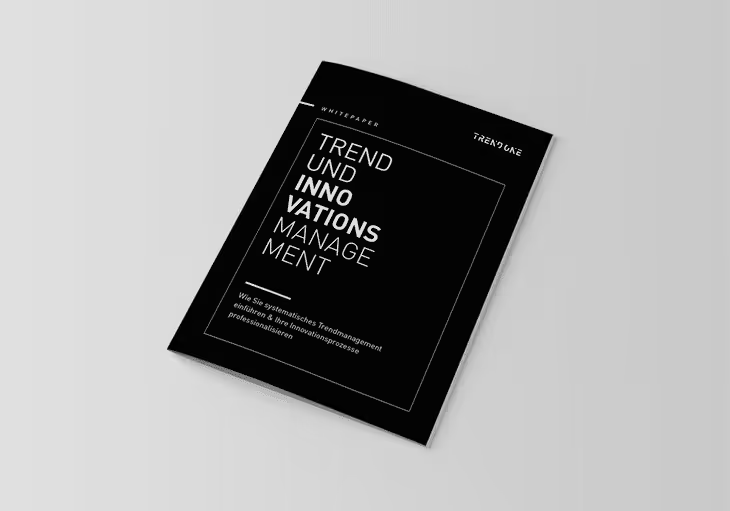
Whitepaper: Trend and Innovation Management
The TRENDONE whitepaper on trend and innovation management shows you how to successfully establish trend management in your company and how to professionalize innovation processes for the long term.