Whether online or offline: commerce is changing drastically. TRENDONE founder Nils Müller and Innovation Analyst Sandro Megerle talk to the online magazine OTTO-Newsroom about commerce in 2035.
Hi Nils, hi Sandro – companies often focus on the question of the next big hype. For you, what would that be?
NILS MÜLLER: To pin down the trends of the future, we first need to look at the past. We travel back to 2003: there were no flat screens, no smartphones, computers were still huge towers with DVDs and scanners. It was a time of upheaval, in which the trends on the economic level were not yet developed. China was producing many counterfeit products and artificial intelligence seemed a long way off. You couldn’t even forecast the World Wide Web.
What surprises will the next 16 years bring?
SANDRO MEGERLE: We like to call these surprises "black swans". For a long time, nobody knew that black swans existed, until researchers discovered them in New Zealand. We are at a threshold where we can only guess at certain innovations that could turn everything on its head. The biggest topic is artificial intelligence. This innovation is spreading everywhere.
Can you give specific examples of areas where AI will take hold in the coming years?
NILS: AI can help create creative content – especially in voice commerce. At some point, the website mechanics we know today will disappear. There might be digital avatars that help me with my shopping. In other words: OTTO will no longer exist as a website, but only as a data set in the cloud, which I can talk to and which adapts to my needs and equips me based on them – a whole new OTTO world.

Wouldn’t it be interesting if my personal avatar knew all my preferences and my daily routine, could make recommendations and book trains and flights for me?
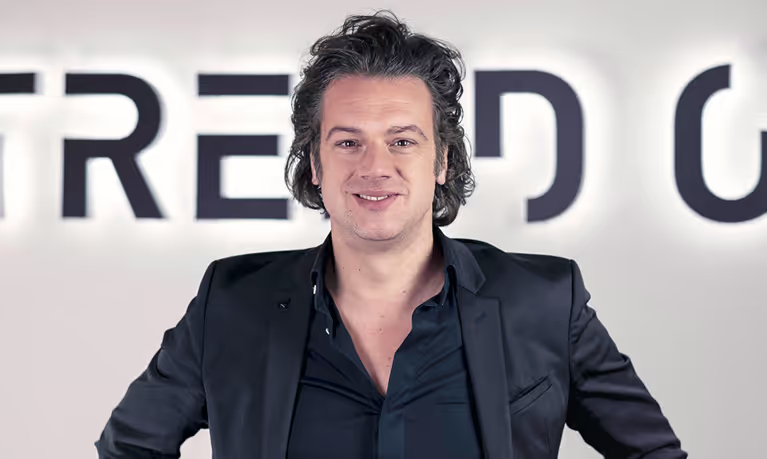
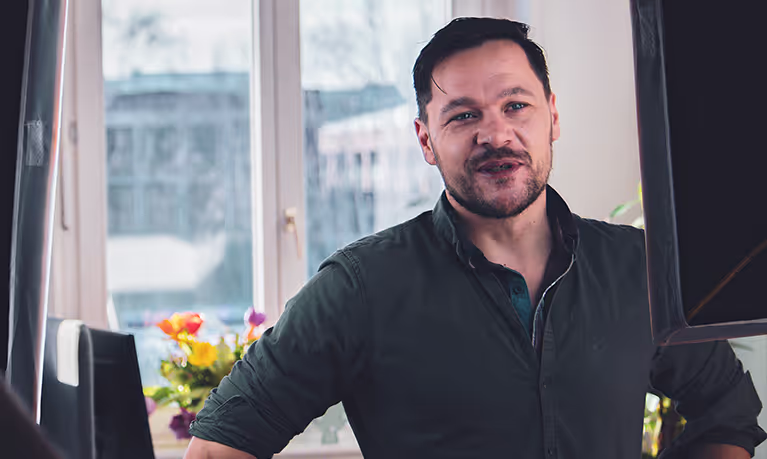
Nils Müller – CEO TRENDONE
That really does sound like science fiction.
NILS: What is exciting is that companies are using more and more predictive intelligence. They want to use data to make forecasts about how a situation will evolve in future. Wouldn’t it be interesting if my personal avatar, my assistant, knew all my preferences, could check my calendar in future, knew my daily routine, and could make recommendations, book trains and flights, and even help me find a new apartment, because the avatar knows my taste?
So the entire supply chain could be fully automated?
SANDRO: Exactly. From the supplier to the marketplace, all the way to the customer and delivery. Delivery would, of course, take place via "autonomous retail". In other words: we travel autonomously and can try on the ordered clothes in a mobile shop that is perfectly pre-configured for the customer. You can already see this in examples from the US and China: autonomous driving is being extended so that shops become mobile and companies save on expensive rent for retail space. This can be a huge topic for rural regions in particular, and a solution to the logistics problem. It would completely turn brick-and-mortar retail on its head.
When you mention examples, do you know of specific projects already being implemented?
NILS: There’s an example from Toyota, with the project name e-Palette. This invention creates an entirely new mobility system. An autonomous delivery van becomes, for example, a pizza shop or a mobile doctor’s practice. The e-Palette concept is designed to transform itself as needed. Even by the 2020 Olympic Games in Tokyo, the service will be available and used for shopping or services such as rest areas. So future retailers will increasingly also compete with leisure offerings.
How important is China for the future and can we benefit from it?
SANDRO: Until now, we still had an aversion to Chinese products and often thought: "China makes counterfeit products, China copies everything". But China has changed a lot, and is now more "copy that" than "copycat". The world can learn a lot from China, especially when it comes to artificial intelligence. Right now, the Middle Kingdom is in the process of overtaking the USA in AI development.
Sustainability is a particularly important topic in European countries. In your view, what should companies contribute to sustainability?
NILS: We really hope that the sustainability trend will hold, so that a lot can be moved over the next 16 years – with the help of technology. We already have technologies like Clean Tech that clean the planet, pull emissions out of the atmosphere, and AI can also make a big contribution. I would also like to see OTTO position itself more strongly here and show how sustainable the company already is today. Commerce should be bold now and provide for the future in sustainable, intelligent ways. SANDRO: The next generation engages much more critically with topics like these, so companies have to keep pushing sustainability forward. They cannot continue as before – "greenwashing" no longer works. The new consumers demand purpose and impact. In the future, companies should not become climate-neutral but climate-negative. Sustainability is not just about saving resources, but also about giving them time to regenerate. We have to tackle the root cause, and ideally companies will boldly lead the way in future.
The term V-Commerce often comes up in connection with future commerce. What does it actually mean?
NILS: It stands for virtual commerce and can be the next step beyond e-commerce. When we think toward 2035, it is not just the visual that matters, but the auditory too – this is called "total immersion". We can dive fully into a virtual world with all our senses, we can feel, taste, smell, hear and see things. When we get there, commerce will have entirely new possibilities.
Imagine going shopping in the virtual world: you walk across a green meadow and pick apples there. The order then ships immediately.
Sandro Megerle – Senior Trend Analyst
Such as?
SANDRO: It naturally dissolves traditional two-dimensional e-commerce. Imagine going shopping in the virtual world: you walk across a green meadow and pick apples there. The order then ships immediately while you are still out in the field. Virtual commerce is exciting and you can see that a lot is happening here. Right now it is still more in a B2B variant: companies can set up a sales floor, draw inspiration, or replan directly if something doesn’t fit. There are also now VR headsets in stores that create a stronger brand experience, describe materials in products or explain a company’s values. On top of that, in 10 years all gamers will be grown-up, spending-ready consumers. There is enormous potential here too, especially for those who engage with the scene now.
Looking even further into the future, say to 2035, what awaits us as human beings? Chips in our brains and immortality?
NILS: Not so far off. We see that humans are shaping the world around them and, for the first time, also reshaping themselves: this movement is often called transhumanism. The user, the customer and the human being develops further – no longer just wearing gadgets like wearables on the body, but upgrading inside the body. High-tech prosthetics, technologies that upgrade us, 3D-printed organs, active contact lenses and chips. Elon Musk has founded Neuralink and wants to use implant technology to measure and optimize people’s brain waves very precisely. In my view, that is the vision and development that will be very exciting from 2025 to 2035.
That is hard to imagine today.
SANDRO: It is. But if we look back to 2003 and tried to tell people from back then that we run around today with little black screens, some of them would also have smiled and waved it off. In 2030 it’ll probably be: "What, you don’t have a chip yet?" That will then be the new normal.
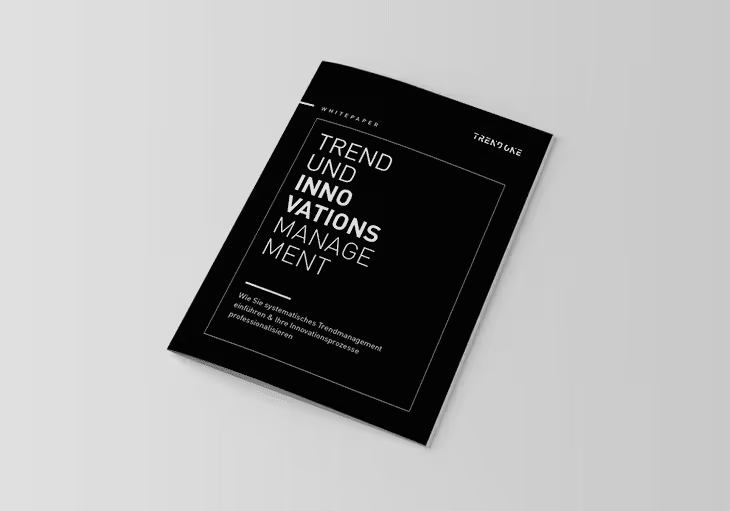
Whitepaper: Trend and Innovation Management
The TRENDONE whitepaper on trend and innovation management shows you how to successfully establish trend management in your company and how to professionalize innovation processes for the long term.